Thursday, January 22, 2015
Thursday Movie Picks: Movies With (a) Colour in the Title
Written for the blogathon hosted by Wandering Through the Shelves. Play Along!
If I'm being honest, I kind of wanted to be really super obvious with this week's stated theme of Movies With (a) Colour in the Title and just go with the individual pieces of Kieslowski's Trois Couleurs trilogy here, but, dammit today is my birthday and I shan't take the obvious path! It is simply not in my nature! And so, without further ado...
Red Eye (2005, Wes Craven) Ladies and gentlemen, the greatest trailer EVER. Okay, maybe not EVER, but definitely one of them (why yes, I do love a good trailer, thanks for asking!). Craven's actually-not-at-all-supernatural thriller isn't quite the mindfuck the trailer seemingly sells, but somehow that works in the movie's favor. Everything feels fresh and surprising, despite us having seen it all before, precisely because of that feeling that there's something lurking just around the corner, outside the frame. Craven, liberated from slashers and monsters and confining himself to one claustrophobic set for most of the (relatively short) running time, is at the peak of his powers here, as are stars Rachel McAdams and Cillian Murphy. Red Eye is a nasty, tight little thriller, perfectly paced and with zero fat. It's the kind of mid-range B-movie you wish Hollywood would make more of, until you realize there's no way they could all possibly be this good.
Touch of Pink (2004, Ian Iqbal Rashid) Alim, a young-ish gay Canadian (of Indian heritage), is happily living in London with his long-term boyfriend Giles, but is so repressed that he still talks to his imaginary friend: a version of in-the-closet Old Hollywood movie star Cary Grant, played with just the right amount of flair by Kyle MacLachlan. Touch of Pink (playing off the title of one of Grant's films, That Touch of Mink) is not a great film, but it's definitely one of my favorite gay films. Taking its cue from MacLachlan's delightful performance, it has just the right lightness of touch. The script is pretty standard-issue gay rom-com stuff (Alim's mom comes to visit, he panics and at the urging of Cary Grant, pushes himself back into the closet), but the actors all know how to make it sing, giving this puffball of a movie a sprightly, enjoyable bounce.
The Purple Rose of Cairo (1985, Woody Allen) Simply put, a must for anyone who loves movies. Who among us hasn't wanted to live in a movie, or to have one of our favorite characters as a friend? I'll have more to say on this one soon (it's a Blind Spot), but for now I'll just say that what I love most about Woody Allen's scrumptious film is how absolutely seriously it takes its fantastical premise.
BONUS SHORT FILMS: The House is Black (1963, Forugh Farrokhzad) If you haven't seen this masterful short, just go to YouTube and do it now. Contrasting powerful, haunting images of an Iranian leper colony and Farrokhzad's readings of the Bible, the Koran, and her own beautiful poetry, The House is Black is twenty minutes of stunning, unforgettable cinema.
The Red Balloon (1956, Albert Lamorisse) One of my all-time favorites, this sweet short is perfect. This is childhood, pure and simple.
Thursday, January 15, 2015
Thursday Movie Picks: Movie Musicals
Written for the blogathon hosted by Wandering Through The Shelves - why don't you join us?
Way to pick an easy one this week! Musicals are only my favorite kind of movie, so I only have about a hundred different movies I could choose to write up for this. Therefore, I had to come up with an extra criterion to even begin writing. Therefore, here are three Non-Hollywood Musicals.
1. The Umbrellas of Cherbourg (Jacques Demy, 1964) I'm not going to lie, this may be my favorite musical of all time. The key to getting into musicals is accepting the very heightened reality in which they exist, one which allows for people to spontaneously burst into song when they're feeling too much to simply speak. In Demy's vision of war-era France, people primarily communicate through singing (yes, very near the whole thing is sung-through), and the mise-en-scene is even color-coded to match their emotions (and outfits), so it helps you along this path. The Umbrellas of Cherbourg is also one of the most swoon-worthy romances in screen history, as teenagers Catherine Deneuve (in her film debut) and Nino Castelnuovo fall madly in love right before he gets drafted to serve in the army, all to Michel Legrand's gorgeous, Oscar-winning score. Will they ever get reunited? All I'll say is that Demy's Palme d'Or-winning film (one of three musicals to claim cinema's most prestigious honor) contains one of the finest ending scenes of all time.
Hey! If you like this one, why don't you try: The Young Girls of Rochefort (1967). Even more candy-colored fun from Demy and Deneuve, with Gene Kelly for extra flavor!
2. Lagaan: Once Upon a Time in India (2001, Ashutosh Gowariker) Even for people who love musicals, Bollywood films can be a bit daunting: At least three hours long, with unbelievably (necessarily) complicated plots, and expensive, expansive musical numbers that often sound like they're sung by particularly nasal children - and all in a foreign language! But what they have in their corner is unrivaled spectacle. My freshman roommate in college was of Indian heritage, and every once in a while he would pop in a Bollywood movie to watch when he was bored, and I would tag along. Thankfully, they had subtitles. Lagaan was the one that stood out to me the most, probably because it's very atypical. Epic even by Bollywood standards, it's an historical drama set during India's colonial British Raj (and thus lacks the sparkle and pizazz of most Bollywood films). The residents of a small, poor village are oppressed by the high taxes imposed on them by the crown, so one of the more arrogant British officers makes a wager: The villagers will not have to pay the tax (the "lagaan" of the title) if they can beat the Brits at a game of cricket. Problem is, the villagers don't know how to play. Can they overcome all the odds and win? The result is a lot more fun than it sounds. Unlike most Bollywood musicals, the songs aren't modern-sounding at all, using period instrumentation. Plus, instead of stopping the action dead in its tracks, they are integrated into the story almost seamlessly. They also tend to enliven scenes that would otherwise be standard clichés (a training sequence, a "let's show those outsiders we have culture, too!" party). At three hours and forty minutes, Lagaan may sound like torture to anyone who doesn't like musicals, but I'm telling you: This is entertainment of the highest order, even if it doesn't sound like it. (BONUS: the film's score was composed by A.R. Rahman, later of Slumdog Millionaire fame.)
Hey! If you like this one, why don't you try: Devdas (2002) Aishwarya Rai is only one of the most beautiful women in the world, and the musical numbers truly have to be seen to be believed.
3. Dancer in the Dark (2000, Lars von Trier) Either you like Bjork or you don't. Either you like Lars von Trier or you don't. But Dancer in the Dark is an undeniable triumph for the both of them. Bjork is simply remarkable as the poor factory worker Selma, who has a genetic degenerative disease which is slowly stealing her eyesight. She saves every penny she can in in the hopes of getting her son an operation that will prevent him from suffering the same fate. Will she be able to do so? In a sort of middle ground between the classic musicals Selma loves to watch with her co-worker Kathy (Catherine Deneuve) and a more naturalistic musical like John Carney's miraculous Once, the musical numbers here come from what Selma hears around her, be it the factory machines, a flag flapping in the breeze, or a train rushing past. And the songs are rather gorgeous - "I've Seen It All" was even nominated for an Oscar (yes, this is where we got Bjork's infamous swan dress). Deeply felt but also typically von Trier in the way it toys with, interrogates, and alienates the audience, Dancer in the Dark is quite divisive despite it's Palme d'Or win. I love the film's subtle stylistic flourishes (the musical numbers are filmed with static cameras with brighter colors than the rest of the film, which used handheld cameras) and incredible performances. Bjork has said she found the filming of this to be so nightmarish that she would never make another film ever again. Whatever von Trier did to her (and I hate to say this), it was probably worth it for this sublime film.
Hey! If you like this one, why don't you try: ...yeah, there really isn't anything like this one. The closest you'd get is probably the aforementioned Once (2007), which is a truly perfect film.
Way to pick an easy one this week! Musicals are only my favorite kind of movie, so I only have about a hundred different movies I could choose to write up for this. Therefore, I had to come up with an extra criterion to even begin writing. Therefore, here are three Non-Hollywood Musicals.
1. The Umbrellas of Cherbourg (Jacques Demy, 1964) I'm not going to lie, this may be my favorite musical of all time. The key to getting into musicals is accepting the very heightened reality in which they exist, one which allows for people to spontaneously burst into song when they're feeling too much to simply speak. In Demy's vision of war-era France, people primarily communicate through singing (yes, very near the whole thing is sung-through), and the mise-en-scene is even color-coded to match their emotions (and outfits), so it helps you along this path. The Umbrellas of Cherbourg is also one of the most swoon-worthy romances in screen history, as teenagers Catherine Deneuve (in her film debut) and Nino Castelnuovo fall madly in love right before he gets drafted to serve in the army, all to Michel Legrand's gorgeous, Oscar-winning score. Will they ever get reunited? All I'll say is that Demy's Palme d'Or-winning film (one of three musicals to claim cinema's most prestigious honor) contains one of the finest ending scenes of all time.
Hey! If you like this one, why don't you try: The Young Girls of Rochefort (1967). Even more candy-colored fun from Demy and Deneuve, with Gene Kelly for extra flavor!
2. Lagaan: Once Upon a Time in India (2001, Ashutosh Gowariker) Even for people who love musicals, Bollywood films can be a bit daunting: At least three hours long, with unbelievably (necessarily) complicated plots, and expensive, expansive musical numbers that often sound like they're sung by particularly nasal children - and all in a foreign language! But what they have in their corner is unrivaled spectacle. My freshman roommate in college was of Indian heritage, and every once in a while he would pop in a Bollywood movie to watch when he was bored, and I would tag along. Thankfully, they had subtitles. Lagaan was the one that stood out to me the most, probably because it's very atypical. Epic even by Bollywood standards, it's an historical drama set during India's colonial British Raj (and thus lacks the sparkle and pizazz of most Bollywood films). The residents of a small, poor village are oppressed by the high taxes imposed on them by the crown, so one of the more arrogant British officers makes a wager: The villagers will not have to pay the tax (the "lagaan" of the title) if they can beat the Brits at a game of cricket. Problem is, the villagers don't know how to play. Can they overcome all the odds and win? The result is a lot more fun than it sounds. Unlike most Bollywood musicals, the songs aren't modern-sounding at all, using period instrumentation. Plus, instead of stopping the action dead in its tracks, they are integrated into the story almost seamlessly. They also tend to enliven scenes that would otherwise be standard clichés (a training sequence, a "let's show those outsiders we have culture, too!" party). At three hours and forty minutes, Lagaan may sound like torture to anyone who doesn't like musicals, but I'm telling you: This is entertainment of the highest order, even if it doesn't sound like it. (BONUS: the film's score was composed by A.R. Rahman, later of Slumdog Millionaire fame.)
Hey! If you like this one, why don't you try: Devdas (2002) Aishwarya Rai is only one of the most beautiful women in the world, and the musical numbers truly have to be seen to be believed.
3. Dancer in the Dark (2000, Lars von Trier) Either you like Bjork or you don't. Either you like Lars von Trier or you don't. But Dancer in the Dark is an undeniable triumph for the both of them. Bjork is simply remarkable as the poor factory worker Selma, who has a genetic degenerative disease which is slowly stealing her eyesight. She saves every penny she can in in the hopes of getting her son an operation that will prevent him from suffering the same fate. Will she be able to do so? In a sort of middle ground between the classic musicals Selma loves to watch with her co-worker Kathy (Catherine Deneuve) and a more naturalistic musical like John Carney's miraculous Once, the musical numbers here come from what Selma hears around her, be it the factory machines, a flag flapping in the breeze, or a train rushing past. And the songs are rather gorgeous - "I've Seen It All" was even nominated for an Oscar (yes, this is where we got Bjork's infamous swan dress). Deeply felt but also typically von Trier in the way it toys with, interrogates, and alienates the audience, Dancer in the Dark is quite divisive despite it's Palme d'Or win. I love the film's subtle stylistic flourishes (the musical numbers are filmed with static cameras with brighter colors than the rest of the film, which used handheld cameras) and incredible performances. Bjork has said she found the filming of this to be so nightmarish that she would never make another film ever again. Whatever von Trier did to her (and I hate to say this), it was probably worth it for this sublime film.
Hey! If you like this one, why don't you try: ...yeah, there really isn't anything like this one. The closest you'd get is probably the aforementioned Once (2007), which is a truly perfect film.
Thursday, January 8, 2015
Thursday Movie Picks: Movies That Feature An Irreparable Mistake
I found this blogathon at Wandering Through the Shelves this weekend and thought it would be a good place to begin my 2015 blogging resolution (basically: Write More, Dammit!). It's easy and fun: Each week, pick three movies that relate to the stated theme. Last week was films featuring a bank robbery (for what it's worth, I would have chosen the French classic Rififi, the recent nutso Now You See Me, and The Italian Job, both versions of which have their strengths). This week, the theme is the more difficult-to-define Movies that feature an Irreparable Mistake. My first pick was easy, my second pick I had to think about a bit, and the third is kind of out there but stands out for a number of different reasons.
1. Atonement (Joe Wright, 2007) It's right there in the title, isn't it? The whole film is about atoning for an irreparable mistake. This is probably a film that should never have been made, considering that Ian McEwan's lovely, lyrical source novel exists solely because of its very literary coup de grace of an ending - something which, while translated fairly well by director Wright and screenwriter Christopher Hampton, doesn't have quite the impact onscreen that it does in the novel's pages. In fact, what strength it does have is almost solely contained in Vanessa Redgrave's master class of a performance, which packs an entire history into maybe five minutes of screentime. But this is still a gorgeous film to behold - especially its first third (Saoirse Ronan's eyes! That green dress!) - and it contains one of cinema's great tracking shots (the stunning, devastating Dunkirk sequence). If it feels a bit at a remove, then that's almost by necessity, given the conceit of the film's ending. But this is a film that has only grown in my estimation in memory and on rewatch, one defined by passion - whether for another person or for righting one's own wrong.
2. I Know What You Did Last Summer (Jim Gillespie, 1997) I have a theory that pretty much any good horror film features an Irreparable Mistake, whether offscreen before the film begins (think Freddy Kruger's backstory in A Nightmare on Elm Street), or as the inciting incident, as it is here. Usually, the Irreparable Mistake is not leaving the damn haunted house, or not calling for help, or leaving your door unlocked, or something similarly stupid. But here, it's a decision of some actual weight: Four idiot teenagers accidentally hit a guy with their car and then dispose of the body (quite poorly, as it turns out). It's not quite as good as screenwriter Kevin Williamson's prior hit Scream, possibly because it doesn't have slasher master Wes Craven in the director's chair, but it has a killer premise and is still fun, and quite the nostalgia trip for anyone who was a teen in the '90s (like me).
3. Audition (Takashi Miike, 1999) I have been trying to think of a way to describe Audition without giving it away ever since I first saw it, mostly because it has such a genius structure and build-up. I think that this is the PERFECT way to do so. The plot is thus: Shigeharu Aoyama is a lonely widower living in Japan. His television producer friend suggests he hold a fake audition for a movie in order to find a new wife, since he has trouble approaching women. I'm not sure that the audition itself is the Irreparable Mistake. I would say that comes a bit later, after Aoyama becomes attracted to the beautiful former ballerina Asami. Like the other two films listed here (this was not intentional), Audition is based on a novel, and is an intriguing exploration of gender roles in modern-day Japan, and any lover of movies should see it (and I say that as someone who usually does not like this kind of movie). Don't read anything about it, don't look it up on IMDB, avoid looking at any posters or DVD covers if you can. Just type the title into Netflix and click play. That's all I'm going to say.
Monday, January 5, 2015
New Year, New Me
I have been a bad boy.
I started this blog because I desperately needed an outlet. I found something I liked to write about that I felt I had good credentials to write about (more or less) and could have a unique opinion on. Unfortunately, it fell by the wayside far quicker than I expected, a victim of a busier-than-expected year in addition to my own fickle and oft-indecisive nature.
But NO MORE!
My New Year's Resolution for this year is to write more. Regularity is key to getting me to do this, and I work better on assignment than on inspiration. So, I will be participating in some blogathons to get back into the habit of writing again. Then, more in-depth writing will come.
Or, at least, that's the hope.
I know I don't really have any "regular" readers at this point - at least, I don't think I do - but consider this post a missive going forward (in case people wonder what a Dance On Film blog is doing not doing much writing about Dance On Film) as well as a division between Old Me and New Me.
As they say... To infinity... AND BEYOND!
I started this blog because I desperately needed an outlet. I found something I liked to write about that I felt I had good credentials to write about (more or less) and could have a unique opinion on. Unfortunately, it fell by the wayside far quicker than I expected, a victim of a busier-than-expected year in addition to my own fickle and oft-indecisive nature.
But NO MORE!
My New Year's Resolution for this year is to write more. Regularity is key to getting me to do this, and I work better on assignment than on inspiration. So, I will be participating in some blogathons to get back into the habit of writing again. Then, more in-depth writing will come.
Or, at least, that's the hope.
I know I don't really have any "regular" readers at this point - at least, I don't think I do - but consider this post a missive going forward (in case people wonder what a Dance On Film blog is doing not doing much writing about Dance On Film) as well as a division between Old Me and New Me.
As they say... To infinity... AND BEYOND!
Wednesday, September 3, 2014
Hit Me With Your Best Shot - The Matrix
Thanks to Nathaniel R. at The Film Experience for choosing one of teenage me's favorite films for the finale of this season of Hit Me With Your Best Shot!
I remember so much about going to see The Matrix for the first time. I was 15 years old, and was wholly entranced by the unbelievably cool marketing campaign: "What Is The Matrix?" all the ads asked, accompanied by the coolest WTF-did-I-just-see visuals anyone had seen (you could make a case for 1999 as the greatest year for movie marketing ever, between this and The Blair Witch Project, and I'm sure there's more). My best friend and I were pushing really hard to go, and finally our parents relented. Except that the theater wouldn't let my mom just buy the tickets for us, she had to actually go in and watch it with us.
This should have been mortifying, but my mom stuck herself in the back row and didn't bother us one bit. When the movie was over, all of us - even my mom - walked out with our mouths open, the only words coming out being, "THAT WAS SO COOL!"
The Matrix then became the unlikeliest of bonding experiences for me and my mom. We went to see both sequels in the theater together (despite the diminishing returns, although I still argue that Reloaded is one of the best action films of the past twenty years), something that previously had only been the realm of Star Wars. Which is fitting, I guess, because in many ways The Matrix was like Star Wars for my generation. The Gen-X philosophizing, the black trenchcoats, the very concept of "the matrix", "I know kung fu", and of course, the stylistic flourish that the film is probably most known for today: Bullet time.
I keep trying to remember when I knew that The Matrix was special, a film that I would love for quite a long time, and I'm pretty sure it's in that very first scene. Very few films open as strongly as The Matrix, with a mysterious phone call as we watch a trace program locate the phone number, followed by police agents moving in on a mysterious woman.
Carrie-Ann Moss is so incredibly badass as Trinity - even in this first shot of her face when she's raising her hands in surrender. You know right away that this is NOT someone you want to piss off, someone who you engage at your own risk. It's an incredible performance, made even better by the flashes of panic and doubt Moss allows to creep in to her statue-like face at various points later in this scene - she paints a remarkably full character portarait in four minutes with almost no dialogue. And then, after Hugo Weaving tells us exactly what we've already suspected of her, this happens:
It's the film's first use of bullet time, but in this context you wouldn't recognize it as such. In fact, it took me a couple of viewings of The Matrix to even realize that the camera isn't moving around a frozen image - Trinity's legs keep rising throughout the shot. It also comes out of nowhere, before any real action has even started. It kicks the movie into high gear and delivers the first of many iconic images from cinematographer Bill Pope. There's even a bit of mystery to it - is she stopping time? Is she supernaturally strong and fast? Who is this badass, black-leather-clad women?
But that's not the moment. Not for me.
For me, the moment that most excited me, that made me go "HOLY SHIT" first, was this one:
I mean, COME ON. She jumps in slow-motion, from roof to roof, ACROSS A CITY STREET. Like I said: BAD. ASS. It's also perfectly set up earlier in the chase sequence, when we see Trinity, the Agent chasing her, and the police officers following him all jump over a much smaller space between rooftops, from the bottom... and one of the cops almost doesn't make it. This is the moment that first scene has been building towards, even though it continues for another minute or so and ends with another iconic image: Trinity in a phone booth, hand against the glass, as if pushing away the truck coming barreling toward her.
After 15 years and countless rewatches, The Matrix still excites. That the (Oscar-winning) visual effects still hold up is a huge reason why; bullet time may have been over-spoofed in the years since, but it hasn't ever been as effective as it was here. Plus, it's not the only trick The Matrix has up its sleeve. The superb construction of its action sequences, the simple yet effective world-building, and the easy yet serious performances all contribute. For me, anyway, this movie's luster hasn't faded one bit.
This post could be retitled "An Appreciation of Carrie-Ann Moss! I didn't plan on writing almost exclusively about Trinity when I started writing this, but she's the first character we meet in The Matrix, and she makes an indelible impression in one of the film's best sequences. And it's a really great performance.
I remember so much about going to see The Matrix for the first time. I was 15 years old, and was wholly entranced by the unbelievably cool marketing campaign: "What Is The Matrix?" all the ads asked, accompanied by the coolest WTF-did-I-just-see visuals anyone had seen (you could make a case for 1999 as the greatest year for movie marketing ever, between this and The Blair Witch Project, and I'm sure there's more). My best friend and I were pushing really hard to go, and finally our parents relented. Except that the theater wouldn't let my mom just buy the tickets for us, she had to actually go in and watch it with us.
This should have been mortifying, but my mom stuck herself in the back row and didn't bother us one bit. When the movie was over, all of us - even my mom - walked out with our mouths open, the only words coming out being, "THAT WAS SO COOL!"
The Matrix then became the unlikeliest of bonding experiences for me and my mom. We went to see both sequels in the theater together (despite the diminishing returns, although I still argue that Reloaded is one of the best action films of the past twenty years), something that previously had only been the realm of Star Wars. Which is fitting, I guess, because in many ways The Matrix was like Star Wars for my generation. The Gen-X philosophizing, the black trenchcoats, the very concept of "the matrix", "I know kung fu", and of course, the stylistic flourish that the film is probably most known for today: Bullet time.
I keep trying to remember when I knew that The Matrix was special, a film that I would love for quite a long time, and I'm pretty sure it's in that very first scene. Very few films open as strongly as The Matrix, with a mysterious phone call as we watch a trace program locate the phone number, followed by police agents moving in on a mysterious woman.
![]() |
| Best Shot Runner-Up |
But that's not the moment. Not for me.
For me, the moment that most excited me, that made me go "HOLY SHIT" first, was this one:
![]() |
| BEST SHOT |
After 15 years and countless rewatches, The Matrix still excites. That the (Oscar-winning) visual effects still hold up is a huge reason why; bullet time may have been over-spoofed in the years since, but it hasn't ever been as effective as it was here. Plus, it's not the only trick The Matrix has up its sleeve. The superb construction of its action sequences, the simple yet effective world-building, and the easy yet serious performances all contribute. For me, anyway, this movie's luster hasn't faded one bit.
* * *
This post could be retitled "An Appreciation of Carrie-Ann Moss! I didn't plan on writing almost exclusively about Trinity when I started writing this, but she's the first character we meet in The Matrix, and she makes an indelible impression in one of the film's best sequences. And it's a really great performance.
Tuesday, July 22, 2014
Hit Me With Your Best Shot - Under the Skin
Despite the fact that I have no time (because I'm dancing too much), I couldn't not participate in this week's episode of Hit Me..., since I'm pretty sure it was me (right here) who inspired Nathaniel to choose Jonathan Glazer's uniquely unsettling mindfuck Under the Skin for the series. It's a film that has refused to leave my mind ever since I saw it in April (with my man, who declared it even worse than "that one about the creation of the universe", referring to Terrence Malick's The Tree of Life, which I dragged him to and lost movie-choosing privileges for a month as a result). I'm not sure if it's a great film or not, but it's certainly unforgettable, and probably the first film I've seen in a theater that can honestly call itself a true "art film".
It's a simple enough film to describe - Scarlett Johansson is a presumably-alien something in a human body who picks up Scottish men to do... something... to them, who slowly but surely becomes more and more intrigued by humanity, even as she is seemingly destroying it. But Under the Skin is so much more than that description, and each time I return to it in my memory, it becomes something different, ever shape-shifting into a completely different film although all its elements remain the same. The film defies categorization in a way entirely unlike anything else I've seen. Is it a parable of female empowerment? A moody science fiction noodle? A fable of "the other"? It is none of these, all of these, and more. On this most recent viewing, it became an existential horror film, the scariest film of the decade. Jean-Paul Sartre, of the "hell is other people" play No Exit, would have loved it.
But, just as when I first saw it in that darkened cinema (absolutely the ideal way to see Under the Skin, and I am so glad I did), what hit me hardest was the film's unbearably, uncomfortably creepy sound design. I will hear the strings of composer Mica Levi's stunning score (which, in a perfect world, would win every award in the known universe) in my nightmares for decades to come. The cinematography is entirely on point (thank you Daniel Landin!), but it's that damn score that really got under my skin... Worse than nails on a chalkboard, every beat of it makes me want to curl into myself, to somehow go beyond the fetal position until I am literally just a ball of humanity.
The images often help with this feeling, though. The opening sequence perfectly sets the mood (and caused more than one person at my screening to walk out), almost completely inscrutable in its presentation of circles and dots converging and and coalescing eventually into a giant eye. It never lets up from that moment on, but by far the most viscerally terrifying sequence (if not the most horrific) is when we see what actually happens to Scarlett's victims. It begins in the above image when her most recent victim reaches out to touch the previous one, and something just at the edge of the frame is not quite right - the skin of a young man shouldn't wrinkle like that, should it? And then, we see it all ripple away, in a simple, perfectly framed and lit shot.
What is left of this man? Just his skin, the rest of him having been drained away, stolen somehow by the inky black void this seductive alien woman led him to. What does it all mean, what does it symbolize? We could debate for hours, days even. But this shot gets at the deepest fear of all human beings, one that our alien protagonist comes to feel all too well by the end of her journey: What makes us human? What is under our skin?
The answer, as posed by this shot? The most frightening idea of all:
Nothing.
BUT, the shot is held for so long that it stops being grotesque and starts becoming beautiful. It hits that meeting place of horror and beauty known as the sublime, and hits it hard. It's also held long enough to give you space to think, to let your mind wander (there are many such moments in Under the Skin, and they're quite possibly the film's greatest strength). Watching this dancing ribbon human skin I started thinking about death, about nothingness - can death, can the very lack of life, something we normally think of as something to hide from sight, be beautiful? I'm not sure, but in this film (here in this shot and again at the very end), director Jonathan Glazer comes up with a pretty good piece of visual evidence that it might be.
But, just as when I first saw it in that darkened cinema (absolutely the ideal way to see Under the Skin, and I am so glad I did), what hit me hardest was the film's unbearably, uncomfortably creepy sound design. I will hear the strings of composer Mica Levi's stunning score (which, in a perfect world, would win every award in the known universe) in my nightmares for decades to come. The cinematography is entirely on point (thank you Daniel Landin!), but it's that damn score that really got under my skin... Worse than nails on a chalkboard, every beat of it makes me want to curl into myself, to somehow go beyond the fetal position until I am literally just a ball of humanity.
The images often help with this feeling, though. The opening sequence perfectly sets the mood (and caused more than one person at my screening to walk out), almost completely inscrutable in its presentation of circles and dots converging and and coalescing eventually into a giant eye. It never lets up from that moment on, but by far the most viscerally terrifying sequence (if not the most horrific) is when we see what actually happens to Scarlett's victims. It begins in the above image when her most recent victim reaches out to touch the previous one, and something just at the edge of the frame is not quite right - the skin of a young man shouldn't wrinkle like that, should it? And then, we see it all ripple away, in a simple, perfectly framed and lit shot.
What is left of this man? Just his skin, the rest of him having been drained away, stolen somehow by the inky black void this seductive alien woman led him to. What does it all mean, what does it symbolize? We could debate for hours, days even. But this shot gets at the deepest fear of all human beings, one that our alien protagonist comes to feel all too well by the end of her journey: What makes us human? What is under our skin?
The answer, as posed by this shot? The most frightening idea of all:
Nothing.
BUT, the shot is held for so long that it stops being grotesque and starts becoming beautiful. It hits that meeting place of horror and beauty known as the sublime, and hits it hard. It's also held long enough to give you space to think, to let your mind wander (there are many such moments in Under the Skin, and they're quite possibly the film's greatest strength). Watching this dancing ribbon human skin I started thinking about death, about nothingness - can death, can the very lack of life, something we normally think of as something to hide from sight, be beautiful? I'm not sure, but in this film (here in this shot and again at the very end), director Jonathan Glazer comes up with a pretty good piece of visual evidence that it might be.
Tuesday, May 6, 2014
Hit Me With Your Best Shot - 3 Women
I have a deep and abiding affection for Shelley Duvall (due to far too many viewings of Faerie Tale Theatre when I was young), Sissy Spacek (due to Carrie), and Robert Altman (due to Gosford Park), so it was a given that I would eventually make my way to 3 Women. It sits in an interesting place in all three of their filmographies: Altman had recently done Nashville, Spacek had just done Carrie, and Duvall was about to do The Shining. Spacek, for one, certainly comes into the film looking quite a lot like a resurrected Carrie White:
![]() |
| She's watching you! |
All buttoned-up with those big, innocent eyes taking everything in with a keen curiosity - and perhaps a slight bit of malevolence.
Believe it or not (and I still have a hard time believing this), Sissy Spacek and Shelley Duvall were the same age when they filmed this: 28 years old. It seems even more impossible when watching how they act opposite each other, especially when they're in a bar and Sissy's Pinky Rose (née Mildred) adds some salt to a beer to make more foam, blows it off, and then drinks the whole damn thing. Or better yet, just compare the above image of Spacek in this film to the below of Duvall's Millie (née Mildred):
![]() |
| "I'm good enough, I'm pretty enough, and doggone it, people like me!" |
They have similar body types - long and willowy with huge eyes, but I never in a millions years would have guessed they were both EXACTLY the same age.
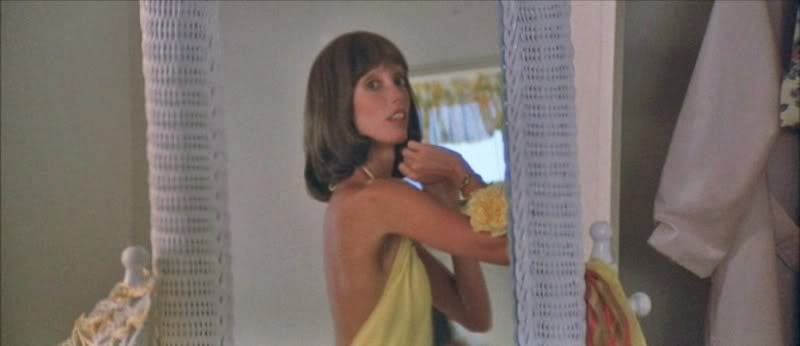
Also, just to digress slightly for a bit, but someone needs to tell me how Duvall's Millie Lammoreaux isn't the biggest goddamn gay icon in the world. First there are the FABULOUS yellow ensembles (like the above which she puts on for a dinner party), then there is the CONSTANT chatter with anyone around without a care for whether or not they're listening, and the OBSESSION with women's magazines and throwing dinner parties with "fancy" food and just fabulosity in general, and FINALLY, there is the tragic downfall, complete with AMAZING cry-face:
![]() |
| Claire Danes could never |
Let's face it people: Shelley Duvall's Millie Lammoreaux is a lost gay icon, and we need to bring her back.
But anyway, back to the issue at hand: Picking the Best Shot.
I had not seen 3 Women before this, and it was somehow both more conventional and far weirder than I had been led to expect. It's certainly enigmatic, as I suppose befits a film that was based on a dream the director had and adapted to a treatment which he planned to shoot without a script. It also contains one of the most stunning dream sequences ever put on film. But it's all pretty straightforward until the last scene, which is so ambiguous that even the director claims to not know what it means. It's almost a prototype version of Single White Female, with Spacek as the girl who becomes obsessed with Duvall enough to take over her life, but it's also not that at all, really. It seems to me to be more about identity itself than the stealing of it.
Actually, the film it reminded me most of wasn't Single White Female, or Persona (which it has also been likened to, perhaps more accurately), but rather Jonathan Glazer's recent Under the Skin, in which Scarlett Johansson is an alien trying a human being on for size. Even as she is focused on her task of seducing men to do... something... to them, she shows a genuine curiosity about her prey and the race to which they belong. For the first half of 3 Women, Spacek gave a performance that felt very much like that, observing the actions of everyone around her, trying to understand what they mean, and trying to imitate them for a bit. She becomes fascinated by a pair of twins, wondering out loud if they switch roles each day and what it must be like. In my pick for best shot, she follows them as they leave work for the day, maybe a little too closely, and eventually starts walking exactly in step with them.
![]() |
| Best Shot |
This is what it feels like to be a twin - to be exactly the same as someone else. She tries it on for size, decides she's gotten enough, and goes on her merry way. And then later on she decides (or perhaps she has already decided) she wants to be exactly like Millie - or does she? The film plays it coy about whether or not Pinky "becoming" Millie is a plot or if Pinky is just suffering from some kind of head trauma, but it's unsettling to watch nonetheless (not as unsettling as Under the Skin, mind you, but still...), and Duvall nails the feelings of fear, depression, and being lost that comes with the potential loss of identity.
(The film also gains a lot of horror from the casting, as Carrie White is pretty much the last person anyone would want obsessing over them - who knows what she'd do if you pissed her off?)
I'm not sure the film has a "titular" three women, although the ending would suggest it's Pinky, Millie, and Janice Rule's Willie. But there are many combinations of three women in the film, including plenty of shots of one woman reflected/refracted into three... and not to mention the women in the striking, haunting murals Willie is always painting. But this was the shot of three that stood out to me the most, and that is most likely to have an effect on my dreams.
BONUS: I don't usually post my "runner-up" Best Shots, but I just have to mention this shot of Janice Rule, which shook me to my core:
The still frame doesn't do it justice, but in motion, there was something about it that was absolutely haunting... and again reminded me of Under the Skin (I'm sorry - I saw that thing a month ago and it has taken up permanent residence in my brain. I still can't shake it - Nathaniel, can we PLEASE do it for next season of Hit Me With Your Best Shot?).
Subscribe to:
Posts (Atom)