Showing posts with label Hit Me With Your Best Shot. Show all posts

Tuesday, May 23, 2017

Hit Me With Your Best Shot: Moonlight

Everybody rejoice, Hit Me With Your Best Shot is BACK! And boy, has Nathaniel picked a doozy for the first episode of the season: Our most recent Best Picture Oscar Winner, Barry Jenkins's gorgeous Moonlight. In both image and theme, Moonlight is one of the most beautiful movies I've seen in a long time, so beautiful that I was drawn back to the theater to see it a second time, and purchased the Blu-Ray recently. It is a film I hold very close to my heart, both for the story it tells and for how it tells it.

Moonlight - if you've been living under a rock for the past year or so - is the story of a young black man named Chiron. It is told in three parts, each named after one of his alter egos. Part one is what everyone calls him as a child, "Little". Part two is his given name, when he's a teenager, and part three is the name he adopts for himself as an adult, "Black". Identity and perception are the twin strands that run through each of Moonlight's three parts, and Chiron's story is mirrored in that of his childhood friend Kevin.

Kevin and Chiron are two halves of the same coin - Chiron is an introvert, Kevin is an extrovert; Chiron is unsure of himself, Kevin is very self-possessed; Kevin is an optimist, Chiron is more of a pessimist. Kevin innately understands how others perceive him and how important that is, Chiron doesn't really, partly because he's so unsure of himself and who he is. Chiron needs Kevin. And Kevin doesn't realize how much he needs Chiron. It's interesting, though embedded in the very nature of the piece, that we are always more sure of who Chiron is than who Kevin is, even though Kevin is ostensibly more sure than Chiron. Is Kevin gay? Bisexual? Or straight-but-open-to-experimentation? It's completely open to interpretation.

Not that any of this necessarily matters when it comes time to picking my best shot. But there's such a surefit of potential best shots in Moonlight that I don't even know where to begin. I mean, right from the beginning, cinematographer James Laxton does an incredible job of putting us right into the mindset of Little Chiron:


As his tormentors rage outside, the camera bobs and weaves around Little in the darkened room of the abandoned crack den in which he's hiding, making the space seem about to cave in on him. Little feels cornered, not just in the moment, but in his life in general. He has no place to run, nowhere to go when everything comes crashing down around him, as he's sure it's going to.

Each of the three sections of Moonlight contains at least one perfect scene. In the first part, that's the "middle of the world" scene, where drug dealer Juan, who's fast becoming Chiron's surrogate father, teaches him how to swim.


It's a perfect image, because of how it reinforces Chiron's independence: Swimming is a solitary act, especially after the person teaching you how to stay afloat lets you go. And in telling Chiron that when he's alone on the water, he's "in the middle of the world", Juan is telling Chiron that Chiron himself is the middle of the world - that he's the only thing that matters. All he needs is himself and the water.

And sure enough, in the second part of the film, when Chiron is feeling particularly down, he heads for the beach. And you can hardly blame him, when his school practically swallows him whole:

Bronze Medal

And of course, it's there, on the beach, that we get another perfect scene, as Kevin and Chiron smoke some weed, kiss, and...


...I trust that's all I have to say, right? That one image pretty much sums it all up, right?

But in all this talk about Chiron, let's not forget that this is just as much a story about his mother, Paula. Paula seems like a decent parent when we first meet her - she's tough, and wary of Juan, but clearly cares for and worries about Chiron. But it's slowly revealed that she's a drug addict, and puts her needs before those of her son, for whom she has some less than motherly feelings. But, despite all of that, she's blood, the one person Chiron can't shut himself out from, the person he will always have to answer for. And we're reminded of that in the most horrifying way:

"I'm your mama, ain't I?" - Silver Medal
A drugged-up, direct address to the camera, the first time a character has looked directly into the camera in the whole movie. But lest you think this shot is all about performance, at the very end of it, Laxton and Jenkins push it into slo-mo, letting her linger a second longer than she should, a ghostly, haunting visage that will follow our hero around until the day he dies.

The third section's perfect scene lasts for most of its entire length: The reunion of Chiron and Kevin after about a decade or so, in a diner where Kevin is working as a cook. He also happens to look like this:


Soooooooo.... yeah, Chiron doesn't really stand a chance, no matter how many defensive walls he's built up over the years.

I really can't say enough about how freaking amazing this scene is. It's a perfect little one-act play unto itself, one in which lingering gazes and interrupted conversations take on the rhythms of a thriller in the most incredible way.

But in selecting the film's best shot, I had to do the obvious thing that I HATE doing, and choose this, the very last shot, which also happens to be the title shot:


Coming as it does after Chiron and Kevin have gotten back together, after Chiron has made his long-overdue declaration to Kevin, after he has finally admitted out loud, to himself and someone else, who he really is, this flashback to Little Chiron is just LOADED. It's a callback to a story Juan tells about his childhood in Cuba (an old woman said to him, "in moonlight, black boys look blue - you're blue!" to which Chiron asks if Juan's name is blue), and a reminder of who Chiron was when he started on this journey. But it's also a direct address to the audience: This boy could be anyone. You could know this boy. And when he is lost and alone, he could turn to you for guidance. What kind of person are you going to be when he does? Are you going to let him struggle to come to grips with himself all on his own, or are you going to offer him the love and support he needs to accept himself? Will you accept him, or will you turn him away?

This final shot is packed with meaning, offering a beautiful end, but not an easy one. It's perfect.

Tuesday, August 30, 2016

Hit Me With Your Best Shot - Splash

Written (for the last time?!? GOD I hope not!) for the series hosted by Nathaniel R. at The Film Experience.

1984 is the year I was born. So naturally, I'm not particularly well-versed in the films that came out around that time. It's nothing against those films, it's just that at the time I was far more interested in eating and pooping and didn't know what movies were. For a long time, though, I just sort of assumed that Amadeus was the greatest film ever made ONLY because it won Best Picture for 1984. Thankfully, it didn't disappoint one bit when I finally saw it years later.


But we're not here to talk about Amadeus. Oh, no. We are here to talk about that OTHER classic from 1984, Ron Howard's fish out of water tale Splash, starring the supremely unlikely couple of Darryl Hannah and Tom Hanks. I had seen bits and pieces of Splash over the years, but this was my first time seeing it all the way through. I have to admit, my reaction to it has somewhat soured knowing that the film was originally written as the story of a mermaid trying to adjust to life in Manhattan, but no one greenlit the script until they flipped it around and made the man she falls in love with the main character. Now, by all means, the original idea might have been the worse movie, but especially in today's cultural climate, I can't help but being a bit annoyed by it... OF COURSE the story originally had a female lead and OF COURSE no one would make it until they changed it to a male lead. AND, to make matters worse/more interesting, the recently announced remake starring Channing Tatum (of all people) in the Darryl Hannah role is said to be based off of one of the earlier versions of the script, meaning that once again the main character is going to be male.

Sorry for the tangent. I just really had to get that off my chest.

Because really, Splash is a perfectly fine film, one that plays just as well today as I'm sure it did back when it was initially released. Sure, Hannah is a little stiff, but that's partly the character, and she really shines in the gorgeous underwater close-ups Howard and DP Don Peterman (aka the guy who shot my beloved Flashdance) give her:

Tuesday, August 23, 2016

Hit Me With Your Best Shot - The Get Down (Episode 1)

I've been reticent to participate in the TV episodes of Nathaniel's Hit Me With Your Best Shot series. Often, a film's best shot won't become apparent to me until the whole thing is over, when the conclusion has been reached and all the film's themes have come fully into view. But an episode of TV is just one big piece of a whole - the show's most important themes may not fully snap into place until the very last episode, or at the very least the last episode of any particular season. So I always shied away from doing them. Until now, when our benevolent overlord has assigned us the first episode of Netflix's new series The Get Down. Why, you ask? Well, it just so happens the series was co-created by mad Aussie genius Baz Luhrmann (director of Strictly Ballroom, William Shakespeare's Romeo + Juliet, Australia, and of course, Moulin Rouge!), and he also directed the first episode. I will follow Luhrmann ANYWHERE, but if he's going to the Bronx in the 1970s to chart the creation of hip hop? DONE AND DONE. TAKE MY MONEY. FEED MY EYEBALLS NOW.


I don't think there's another filmmaker alive today who so gets the full-on rush of adolescence AND the act of creation on the same level as Luhrmann, and I have been dying to see what he would do in a more grounded, less fantastical setting. So I was very eager to watch The Get Down. Even after the very mixed reviews - Luhrmann tends to inspire love-or-hate reactions. But then I actually watched it.

There's no two ways around it: The Get Down is an unholy mess of a thing. BUT - and this is a VERY BIG but - somehow the mess feels right. It's been reported that production on The Get Down started before the creative team really knew exactly what it was, and the first episode especially reflects that. But on the other hand, you can see exactly WHY it was so difficult for them to get a handle on just what it was they were creating. Music - and hip-hop in particular - is so tied to the culture of its creation that you can't just make it about the music. You have to also explore the community in which it was created. And hip hop - as far as I understand it - was basically birthed in 1970s New York, one of the wildest, most sprawling, multi-faceted communities ever. So by necessity, you have to have all these additional elements - cultural, political, economic, religious - because they are embedded in the very fabric of the story you're trying to tell. And given the amount of time you have to tell a story in a TV show, you can actually delve into all those elements.


So The Get Down may be a mess, but it's a necessary mess, and it is BEAUTIFUL within that mess.

But I had the exact problem I had predicted with attempting to choose a Best Shot from the 90-minute pilot episode: Which of the show's myriad elements is going to really take off after this first episode? Is it going to be the young love story between young poet/nascent rapper Ezekiel and daughter of a preacher man/wannabe disco diva Mylene? The political corruption subplot with Jimmy Smitts? The criminal underbelly of the world headed by Lilias White's Fat Annie? The coming-of-age story that connects all the teenagers? Or the magical realism that spreads throughout the pilot but is most apparent during the scenes with hustler/sometime graffiti artist/aspiring DJ Shaolin Fantastic?


I've now watched three episodes of The Get Down, and it's still a bit of a mess, but I think I know where the heart of the series lies, and what makes it special. The Get Down is completely unlike anything else on TV, and what contributes most to that is the show's elements of magical realism. They're spread out throughout each episode, but they're important. Music is what connects most of the main characters (if not all of them), and it mainly serves as an escape from the oppressive nature of their world. Their community is basically a ghetto, with buildings burning down and funding for firefighters disappearing, plus it's summer, when the city gets hot, sweaty, sticky, and cramped - when nature itself is at its most oppressive. Music provides an oasis of cool and calm, and when it appears, the series becomes something new, something different. The feeling of those sequences is unlike anything else I've ever seen, but I couldn't find one shot in the pilot that sums them up. But there is this shot:

BEST SHOT
It's a little hard to tell in this screengrab, so click and make it bigger. This is the main crew (dubbed The Fantastic Four Plus One by Shaolin Fantastic) walking home late, late at night. Past a burnt-out vacant lot, by the light of various solitary streetlamps. It almost looks like something out of a fantasy, except it's not. This is all too real. But the magical feeling of making music together at an underground DJ session/rap battle infuses the very air with something extra, making the might feel magical, maybe even a little beautiful. Finding something deep in your soul like that, connecting with others when the world outside is unfriendly and harsh and hot, can make even the deadest of dead end streets look like the most beautiful place in the world, and Luhrmann (and DP William Rexer) captures that to perfection in this shot.

Tuesday, August 9, 2016

Hit Me With Your Best Shot - Some Like it Hot

One of the things that it's easy to forget about Billy Wilder's comic masterpiece Some Like It Hot is that it's actually a bit of a gangster movie. In fact, the opening minutes are so good at it that you'd be forgiven for thinking someone mixed up the reels and put on a Warner Bros. picture instead.


Wednesday, July 27, 2016

Hit Me WIth Your Best Shot - 1977: JULIA

Fred Zinneman's Julia is kind of a strange picture. Memory, speculation, and the present intermingle in very off-beat ways in the first reel of the film, as Jane Fonda's Lillian Hellman has trouble writing her play and thinks of her best childhood friend, Julia (the inimitable, Oscar-winning Vanessa Redgrave). Or maybe she's having writer's block because she can't stop thinking of Julia?

I don't know, it's hard to say. What shocked me the most about the film was how I kept thinking that the whole storyline really only made sense as a queer romance, and how well Fonda was portraying that just under the surface.... and then the film ACTUALLY WENT THERE. TWICE. First, Lillian actually says "I love you," to Julia in a way that is more than just strictly friendly. Second, one of Lillian's very drunk friends first insinuates (I think?) that he had something incestuous going on with his sister when they were teenagers, and then tells her that everyone knew about her and Julia. Color me shocked. It never goes farther than that, but it was much farther than I ever thought the film would go, and even arguably farther than it would if the same film were made today, shockingly enough.

"I love you, Julia"

Because of this, I was very tempted to pick a shot of the two ladies together, particularly in what is far and away the film's best scene, their reunion at a Café in Nazi-era Berlin (Julia is a member of the resistance and has tasked a rather frightened Lillian with smuggling a large sum of money across the border from Paris). Or, even more so, the first time I got an inkling as to there being a little something more in that relationship, when they dance with each other in their nightgowns on New Year's Eve.


But in the end I couldn't go with any of the pictures of the actresses. What really made the film for me, was DP Douglas Slocombe's shots of the train Lillian rides for the film's middle third (a very solid thriller despite the fact that Fonda overplays it, with help from whoever was applying her sweat). They're beautifully lit, and provide far better context for the world in which this story is taking place than the many deliciously designed interiors that make up most of the film.

SILVER MEDAL
This is when the train taking Lillian to Berlin first leaves Paris, and it's both gorgeous and foreboding in equal measure, a perfect set-up for what's to come.

But my pick for Best Shot struck such a chord that it shocked me right of the reverie the film had lulled me into. I can't claim it's in as technically brilliant a shot as my runner up, but thematically, it packs a wallop.

BEST SHOT
A steam train rolling a through wintry snow. Not particularly noteworthy, right? But remember, the train is coming up on Berlin at the start of the Third Reich. The image of a train in Germany at that time, and snow falling like ash from the gray sky, is one that has a hell of a lot of baggage. It was only at this point that I fully grasped what was going on in the world around Lillian, and just how much danger she, a Jewish American woman, was in going to Berlin at this time. I can't think of a more concise way to make that statement than with this image. Besides what the image calls to mind, it's also the only shot in the film that barely has a single color in it - it might as well be in black & white. The reds and browns and greens that have dominated the film so far are all but gone here. It's a cruel cut just when you think the worst part of Lillian's journey is behind her, a hugely impactful image set up and inserted into the film for maximum impact.

Tuesday, July 12, 2016

Hit Me With Your Best Shot - Gentlemen Prefer Blondes

There were Technicolor pictures made before Howard Hawks's Gentlemen Prefer Blondes, and there were Technicolor pictures made after it, but I don't think there is one that is MORE of a Technicolor picture than this one.


I MEAN. Have you ever seen such red? Even Dorothy's ruby slippers don't come close to this. And Hawks (and DP Harry J. Wild) knows just the best ways to make sure the colors of costume designer Travilla's glorious costumes really pop:

Tuesday, July 5, 2016

Hit Me With Your Best Shot - Working Girl

Written as part of the series hosted by the great Nathaniel R. at The Film Experience. Go and read!


It's impossible to oversell how incredible the opening credits sequence of Mike Nichols's Working Girl is. That soaring shot around the Statue of Liberty to the Manhattan skyline to the Staten Island Ferry is just awe-inspiring, and when combined with Carly Simon's music, it's nothing short of perfection, selling you on everything our main character wants before we've even met her.

Tess works as a secretary in one of those nebulous corporate businesses that seem to do everything at once but exist for no real purpose other than making money. She's also been going to night school to get her degree, and so she's smart and a real go-getter. But unfortunately, the fact that she looks like Melanie Griffith means that no one thinks of her in that way. Until she gets placed under Sigourney Weaver's Katherine.


And that's when things get interesting.

As the film goes on, it becomes clear that what we're seeing is a duel between two different kinds of femininity: Katherine's take-no-prisoners ambition, wielding sexuality as a weapon to get what she wants vs. Tess's quiet, growing confidence, moxie, and use of street smarts (AKA "women's intuition"). Who exactly is slyer, and whether she gets the reward or punishment she deserves says more about the viewer than it does about the film itself, mostly because of Mike Nichols's pitch-perfect direction.

See, it would appear as though the film is on Tess's side, but let's not forget that the only reason she finds out about Katherine's stealing of her idea by single white female-ing her while she's recuperating from a skiing injury. And she still lies and manipulates her way into a big deal, a better job, AND a swoon-worthy man - not all that different from what Katherine was doing to her.

The difference between Katherine and Tess is razor-thin, and hinges on one thing and one thing only: Tess's status as underdog. If you love a good underdog, rise-up-by-your-bootstraps story (and let's be honest, who doesn't?), you're on Tess's side, thinking that the ends justify the means. But I can easily see powerful people of both sexes, but particularly women, being on Katherine's side - the woman knows business and was only doing what she had to do to get ahead in a world that sees women as objects, not equal partners. Her only "crime" is trying to pass off someone else's idea as her own, and then trying to save herself when she was found out. Any one of us could have done the exact same thing if the circumstances were right. While the script on the face of it seems to reward the more traditionally feminine, unassuming Tess, and punish the more masculine, aggressive Katherine, Nichols never seems to really want to go there. He seems to get how problematic that construct is, and works against it whenever possible.

As much as the script tries to make Katherine a hateful, heinous bitch (with Weaver alternately playing to that and away from it, brilliantly), Nichols keeps trying to cast some shade on Tess wherever he can. It's not just that the scene where Tess uses Katherine's apartment plays so queasily - there is no trace of wish-fulfillment fantasy here - it's in the way Griffith says "Well, if that's the way you want to go..." when a colleague of Katherine's gives a suggestion on catering a dinner party; it's in the way that Olympia Dukakis's HR rep tells Tess that none of her previous superiors in the company will vouch for her; and it's in the way that Tess slowly but surely moves away from her Staten Island friends throughout the movie.


Sure, Joan Cusack's Cyn is always there ready to lend a hand, but they are practically inseparable when the movie begins, and as the film goes on they are farther and farther apart in many scenes, until at the end they're in two completely separate spaces. At first, Tess's status as a Staten Islander is a defining trait. But she's already trying to eradicate her accent, and then she loses her jewelry, and then her big hair, and then nearly all of her ties to her home, family, and friends. How is the erasing of Tess's uniqueness (in the context of the film's business world) a good thing? Is the message here that you have to change yourself to get ahead?

The film's last shot, a reversal of the opening track in on the ferry, certainly has irony written all over it: For all that she's done, Tess is now just one of many faceless businessmen and women in one of many multi-company skyscrapers in Manhattan. It's both a huge accomplishment and not so much of one.

Best Shot Runner-Up

It's hard for me to say exactly when this reading of the film occurred to me. The seeds were planted in this early shot of Katherine at her dinner party (with dim sum served by Tess, apparently because she only suggested a caterer and not wait staff - is Katherine punishing her or did Tess offer?). She instantly stands out, and the film constantly associates her with the color red from then on. It's clear she's a woman trying to make her way in a man's world, and using everything she has at her disposal - money, smarts, sexuality - to do so.


Then there was that deeply uncomfortable scene with Tess in the absent Katherine's apartment, specifically the moment when she starts putting on Katherine's make-up and perfume, which is just deeply, deeply creepy while still somehow not feeling too out of place in the context of the film. And then came the ending, which Nichols seems to complicate as I've detailed above.

But then there was this shot, seemingly a throwaway gag, but on second look very revealing about Katherine's character:

BEST SHOT

She has made so many friends in the hospital after her accident, and she's having a great time enjoying herself while not being at work. And AT THE SAME TIME, it can just as easily be read as Katherine being a callous woman tossing orders around at Tess while she is having the time of her life, blithely not giving a damn about work or the well-being of others (look how she even got a nurse to give her a pedicure!). It's maybe not the most arresting shot in the film, or the one that provoked the biggest reaction out of me, but it's the only one in the whole film that I actually went back and looked at again and saw a deeper meaning. And in a seemingly bland, of-its-time comedy, that's pretty impressive.

Tuesday, June 28, 2016

Hit Me With Your Best Shot - To Catch a Thief

To Catch a Thief is one of my favorite Hitchcock films. If I'm being honest with myself, it's not one of his best, but it is oh so very good at being what it is - an entertaining, luxe, escapist thriller - that it is always in my Top Ten Favorite Hitchcocks. Few of the Master of Suspense's Hollywood films are so purely entertaining, and none have as much glamour.

I love many things about To Catch a Thief, but we are here to discuss cinematography. And there are three things I really love about the cinematography of To Catch a Thief.

1. The location photography, including best rear-projection driving scenes in Old Hollywood.


2. The visual wit. This is one of Hitchcock's wittiest films visually.


"Un poulet!"


3. The green-ish nighttime hues.


"Mother, the book you're reading is upside down!"

That last one is my favorite moment in the film, a perfect example of the film's wit. But I felt weird picking it for the Best Shot, since what makes me laugh is the placement of that line of dialogue. My Best Shot comes near the end of the film, as Cary Grant's retired cat burglar John Robie hides out on the roof waiting to catch his copy cat. We've only just found out that the costumed gentleman dancing with Grace Kelly's danger whore Francie all night was not John but rather the insurance adjuster working with him to protect the jewels he has insured, and Hitch cuts right to John on the roof and does the magnificent pull-out (which I wasn't able to gif):


It's so stunningly lit, and the camera moves so perfectly, and it puts you right into John's slightly vertiginous head space - he knows what he's doing, he's in his element, but he's nervous. If he doesn't catch this guy, he's going to jail for something he didn't do. And might also lose a beautiful woman in the process. It's an effortless shot, just like the whole film.

Tuesday, June 21, 2016

Hit Me With Your Best Shot - The Bitter Tears of Petra von Kant

Written as part of the series hosted by everyone's favorite Nathaniel R. over at The Film Experience.

HAPPY PRIDE WEEK, EVERYBODY!!!

Yes, it's Pride Week! Which means it's time to watch some sad, depressed, horrible gay people abuse each other on film!

Yes, it's Rainer Werner Fassbinder's The Bitter Tears of Petra von Kant! And what you see in the title is EXACTLY what you get. Bitter Petra von Kant and lots of tears. All while looking FABULOUS!

Sorry. I know I'm not giving this film the write-up it really deserves. It's just.... IT'S PRIDE WEEK! And this film really ruined my buzz, man. But more importantly, there is A LOT to unpack in this movie, and I feel like I need to see it at least once more before I can even begin to do that. Suffice it to say, that if you are at all a fan of actresses acting circles around each other, this a must see, featuring an absolutely unbelievable performance from Margit Carstensen in her film debut as the title character. She is fucking tremendous in this part, nailing Petra's fashion designer hauteur and performative nature as well as the bruised, wounded woman underneath. It's all the more astonishing for some of the clothes and wigs she had to wear while giving that performance.

Fassbinder and his cinematographer, the legendary Michael Ballhaus, manage to find every possible angle to film characters in the space the entire film is set in, Petra's combination bed/sitting room-cum-design studio(?), resulting in a film that is never not interesting to look at. It is really kind of incredible, but what struck me more than the lighting or the camera movements (which were at times incredibly expressive) was the blocking of characters in the space. Particularly Marlene, Petra's put-upon assistant, who is constantly in the background of scenes, ever so slightly out of focus.


And they also make wonderful use of mirrors and windows, which often cause people to be both talking to each other and not at the same time, showing how Petra views and relates to other people (i.e., only in terms of herself):


And the use of the giant painting that takes up one whole wall of the room is just stunning, too, instantly presenting the beautiful Karin, whom Petra takes as a lover/muse for a time (and who, of course, ends up leaving her. For a man) as a gift from God:


But I keep coming back to two things about Bitter Tears: Marlene and the mannequins. I was absolutely fascinated by and utterly taken with Irm Hermann's performance as the silent, black-clad Marlene, the very definition of a "long-suffering assistant" who may or may not be actually doing all (and I do mean ALL) the work of Petra's design business. It's very clearly the work of a very green actress, but in the opening credits, Fassbinder dedicates the film to her, and it's easy to see why. She is the film's heart and soul, and even if the actress appears to have none of the character's inner life, there are moments when her eyes cut right through you:


And they use her smartly, perfectly encapsulating everything about the character - just how much she suffers, and just why she does it - in just one shot:

RUNNER-UP
But as expressive as that shot is, I had to go with the mannequins for the Best Shot. So much of the film is about the performative aspect of sex/sexuality - how we present ourselves, how we lie and play parts, how we hide or ignore or knowingly exaggerate one way or another - and I was drawn to how Fassbinder constantly had Petra's mannequins posed around the space as if they were mirroring the action (or in at least one case, gossiping on it). And then, near the end of the film, when Karin is long gone and Petra is in deep, DEEP despair, her former bedroom now completely empty but for the wall painting, the shag carpeting, and a phone that Petra desperately waits for Karin to call her on, we see this:

BEST SHOT
Petra (or Marlene, who knows?) has staged her mannequins in bed, two having sex and one watching. It's a bit ambiguous: Are the two in bed meant to represent Petra and Karin, with the watcher being Marlene? Or society? Or are the two in bed Karin and a random lover, with Petra watching? Either way, what matters is that this is all Petra and Karin ever were - they weren't REAL when they were together. Petra didn't want to hear truth from Karin (or perhaps from her ex-husband), she wanted what she wanted to hear. Karin knew this, and it's part of why she got bored and part of why she left. Petra's feelings towards Karin weren't love, but obsession. She was reaching for something we want to be easily definable but in reality is anything but. She was going through the motions, trying to find something to fill a void, and desperately trying to make it fit. You can pose yourself however you like, but it's not love unless you're real.

Wednesday, June 15, 2016

Hit Me With Your Best Shot - One From the Heart

To call Francis Ford Coppola's One From the Heart "stylized" would be an understatement. To call it "artificial" would be even more of an understatement. It is, by a pretty good margin, the strangest American film I've ever seen, and were it not for Nobuhiko Obayashi's completely batshit insane House, it would be the absolute weirdest fucking film I've ever seen, period.

To begin with, it takes place in Las Vegas, and takes the artificiality of that city as far as it can go: The entire thing is shot on a soundstage, and looks it. BOY does it look it.

SILVER MEDAL
Then, there's also the almost expressionistic lighting, shading nearly every scene in neon shades of red, green, blue, and yellow.

They're about to do it, so they put on the red light

And on top of all that, it's mostly shot in a series of long takes, which often overlap with others that may or may not be taking place in the same place/at the same time, sometimes to wondrous effect, sometimes to disastrous effect. I say "disastrous" because of that whole "may or may not" caveat. There are times when characters appear to cross paths (they actually cross right in front of each other, in full view, and we watch them do it), except then the camera pulls back to reveal that the second character is actually not in the same place at all. Which makes it more confusing when it happens later and the two characters actually ARE in the same space at the same time.


And as if ALL THAT weren't enough, it's all set to a song score by Tom Waits that is near-constantly blaring on the soundtrack. If ever there was a musical film that was ashamed to be a musical, it's this one. The characters never sing, the songs just play like a third-person narrator or Greek chorus that we never see. Except that the songs don't really ever make that much of an impression, partly because they all sound very similar, partly because it's occasionally difficult to make out the lyrics over the dialogue, and partly because the lyrics don't always seem to fit quite right with the story as it's presented. Songs in musicals come organically out of the narrative, when a feeling is so strong or a situation so important that expressing what's happening in mere dialogue simply isn't enough. But the songs in One From the Heart aren't really used that way. Or at least it doesn't feel like it.

Tuesday, June 7, 2016

Hit Me With Your Best Shot - Trevor

Goddammit.

This is easily the hardest episode of Hit Me With Your Best Shot I've ever participated in, and I'm including in that the Crouching Tiger, Hidden Dragon episode, which I didn't participate in because despite trying three times, I found myself unable to remember that I was supposed to be looking for a best shot, so caught up was I in Ang Lee's deft, magical storytelling.


It's not just that Trevor is a very, VERY good short film, and that I could very honestly pick pretty much any shot from it and come up with a justification for why it's the Best. It's that I had never seen the short that birthed The Trevor Project before, and I didn't put two and two together and realize that this lovely short was even related to that SUPER important organization before watching it, and was thus totally unprepared for what I was about to watch.

I LOVE the little Harold & Maude phase Trevor goes through at the beginning

Tuesday, May 31, 2016

Hit Me With Your Best Shot - Morocco

Written as part of the series hosted by the lovely Nathaniel R. at The Film Experience, THE essential site for film lovers and actressexuals of all shapes and sizes!

What becomes a legend most?


Not caring. Not having any ever-loving fucks left to give. THAT is what becomes a legend most. For what does a legend care for the peons of the world - those people beneath her who would grovel at her feet for the chance of getting a glance from her ever-shrouded eyes, the "little people" who encompass most of us? ABSOLUTELY NOTHING.


Oh, she may have her reasons. She could be so insanely talented that everyday trivialities are nothing to her. She could be so unbelievably beautiful that she simply cannot bear to look at anything not as lovely as she. Or, she could have been hurt so deeply and so often over the course of her life that she has realized that there's nothing left in this world she could possibly give a damn about.


Except maybe this man. Because let's be honest, who wouldn't?

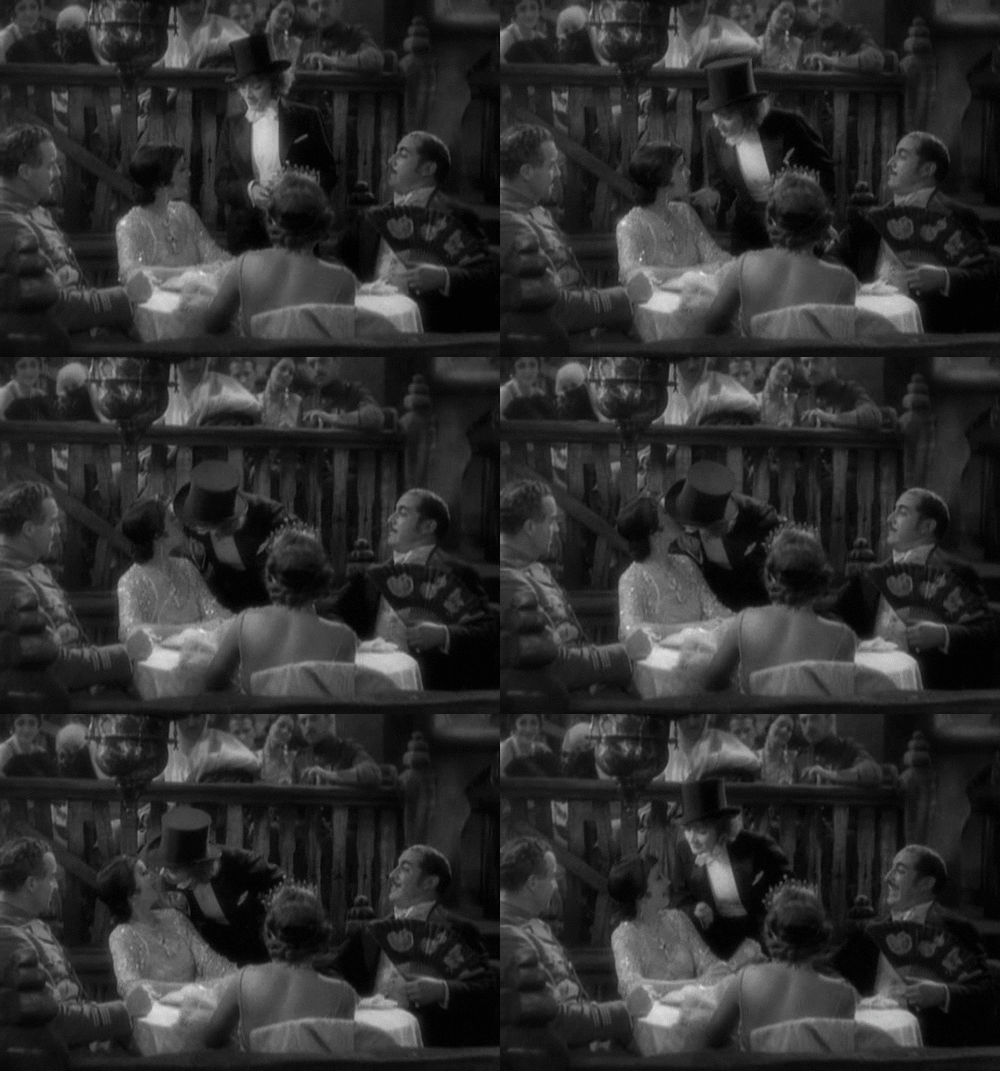
Josef von Sternberg's Morocco wasn't my introduction to Marlene Dietrich (that would be Alfred Hitchcock's Stage Fright), but it was my introduction to the work that defined her (with von Sternberg), and somehow I hadn't watched it until now. Well let me tell you, the lady is AMAZING. Amy Jolly is the baddest bitch on the seven continents and then some. Help her pack up her luggage after it collapses open on a boat? Whatever. Employ her to sing at your café in the titular country and give her advice on how to work the crowd? Alright, fine, if you must. But you best believe that when she does deign to pay attention to you, she will only do so with complete and utter disdain:

Silver Medal

Basically, that same insouciance that makes Buster Keaton one of the silver screen's greatest comedians makes Marlene Dietrich one of its greatest Divas. She is the living personification of the old adage "Less is More," and it took me seeing Morocco to realize it.

Bronze Medal

Watch as one by one she singlehandedly disarms every single man around her! Thrill to her shocking performance in... SHOCK... menswear! Gasp as she works the crowd by kissing a woman full on the mouth! IN 1930!!!

She kissed a girl. She liked it.

But when she finally gets Gary Cooper alone, she reveals where that give-no-fucks, take-no-prisoners attitude comes from. She's been let down by a few too many men. Turns out, her strength comes from a place of deep sadness, a mask she puts on to get through the day. We finally see the real Amy(/Marlene) in this shot, just as Cooper's legionnaire tells her that he wishes he had met her ten years ago - before he joined the Foreign Legion:

BEST SHOT

He's all but told her he loves her, and she looks like she's just been told she has forty-eight hours to live, like she's going back into hiding after sticking her nose out of her hole. Von Sternberg even has her dressed in black and boxed into the frame - here she is, in the same trap she's found herself in time and again, and the only way out is to cut it off now, before she gets in too deep. Again. What a beautiful character moment - one that makes you see her in a completely different (but still drop-dead sexy) light.