Written as part of the weekly blogathon hosted by Wandering Through the Shelves. Join in the fun by picking three movies that fit the week's theme and writing a bit about them!
After the past few years of American politics, we all need a good political comedy, even though they may be just as painful to watch as dramas. But even when what's happening on screen is eerily, uncomfortably close to what's happening in real life, laughter is the best kind of catharsis. These are three of my favorites.
In The Loop (Armando Iannucci, 2009) This satire of the run-up to the Iraq war, a spin-off of the brilliant British TV series The Thick of It is one of the funniest films ever made. When Minister for International Development Simon Foster (terrifically bumbling Tom Hollander) keeps digging a deeper hole for himself every time he opens his mouth around the media, the Prime Minister's Director of Communications, Malcolm Tucker (the shoulda-been-Oscar-nominated Peter Capaldi) is sent in to fix things. Except that American Assistant Secretary of State for Diplomacy Karen Clark (hilarious Mimi Kennedy) got wind of Foster's statements and wants him to help her as she tries to undermine Assistant Secretary of State for Policy Linton Barwick's secret war committee. It's all a tangle, and a flawless ensemble of American and British actors pull it off, giving Iannucci fantastically profane script (Malcolm's preferred sign-off phrase is "Fuckity-bye!") plenty of punch.
The Great Dictator (Charlie Chaplin, 1940) For his first true sound film, Charlie Chaplin sure went there, didn't he? A Jewish barber just so happens to look exactly like the ruthless dictator Adenoid Hynkel (who may look rather... familiar to you), and when Hynkel orders a purge of the Jews, it may be up to the barber to save his people... and the rest of the people of the country of Tomania. One of the most important works of satire ever filmed, The Great Dictator is brilliant, and brilliantly funny.
Duck Soup (Leo McCarey, 1933) The Marx Brothers at their zany best, which is actually what makes this satire somewhat difficult to watch. They are talking about political intrigue and war, after all. But really, the hilariously on point songs and the justly famous mirror scene put Zeppo's final film with the group over the top.
Written as part of the weekly blogathon hosted by Wandering Through the Shelves. Join us by picking three movies that fit the week's theme and writing a bit about them!
Clever theme title this week! I have to admit, but biggest fear, still to this day, is being alone in the dark. It's not as crippling a fear as it used to be, thankfully. When I was younger, it could take me hours to go to sleep in my own bed because of how scared I was of the darkness. The darkness is the unknown, it obscures what we know and twists it into something other. It can be difficult for movies to truly capture that, since a large part of the experience of watching a movie is... ya know...being able to see what's going on. But these movies do a good job of capturing the terror of the darkness and nighttime.
Snow White and the Seven Dwarfs (David Hand, et. al., 1937) In a deviation from my usual modus operandi, this whole movie isn't about this week's topic, or even mostly about this week's topic. BUT, the sequence above is about as perfect a depiction of being surrounded by darkness as it gets - it shows very artistically and VERY effectively how in the dark, things become something far more sinister than what they actually are, and how everything - EVERYTHING - has eyes that seem to follow you as you get more and more lost. This was the first thing I ever remember seeing in a movie that well and truly scared me.
The Blair Witch Project (Daniel Myrick & Eduardo Sanchez, 1999) Sometimes, it's not about the things that surround you in the dark, but the darkness itself. The absence of anything, the inability to see beyond a few inches in front of you. No movie I've seen captures that feeling quite like The Blair Witch Project, which made my entire family so afraid of the dark that after seeing it, it took all four of us to bring one garbage can from our garage to the end of our driveway. By now, everyone knows the story of the three student filmmakers making a documentary in the woods of Maryland who disappeared, leaving only this footage behind (and how the marketing was so effective that many people believed it actually was a documentary). It basically created the "found footage" genre, and has all the positive and negatives one associates with films of that ilk. But as with so many trendsetters, it became famous for a reason, and that reason is that Blair Witch gets down and dirty with our fear of the dark, and what unknowns lurk just beyond our sight and our grasp. And because it knows that when shit hits the fan, most of us wouldn't serve up a clever quip and stand our ground; we'd curse to high heaven and run like hell.
Lights Out (David F. Sandberg, 2016) One of the movies I've seen as part of my 31 Days of Horror this year, and specifically with this week's theme in mind! I don't think I would have survived seeing this in the theater, although honestly the 2013 short that it's based on is maybe better. But that's only because in service of making an entire feature, there had to be, ya know, a story to build the concept around. And the story, which is a metaphor for depression, is a bit too obvious and the film sort of runs the metaphor into the ground. BUT. The scary scenes, dealing with the ghostie who only appears in darkness, are SCARY. Had I seen this when I was younger, there would have been NO WAY I would have been able to sleep with the lights out, which is surely the exact reaction the film was going for.
Written as part of the weekly blogathon hosted by Wandering Through the Shelves. Join the gang by picking three movies that fit the week's theme and writing about them. It's fun!
I've always been obsessed with the legends of King Arthur and Robin Hood. These twin obsessions come from different places - the first from the Broadway Cast Recording of Camelot, which I had a strange love for even at an early age (I would put on my parents' record of it, get up on a chair, and sing King Arthur's opening song to a non-existent audience... A LOT), and the second I think from a movie I saw when I was young... although that last bit could apply to the first, as well. Which is perfect, because this week on Thursday Movie Picks, we're talking about Legends and Mythology!
The Sword in the Stone (Wolfgang Reitherman, 1963) For my money, one of the most underrated of Disney Animated Classics, although I can understand why. The episodic nature of this telling of King Arthur's young adventures under the tutelage of Merlin the Wizard (based on T.H. White's The Once and Future King, EXTREMELY loosely) means that it's mostly plotless and meandering, and there isn't a true antagonist until three-quarters of the way through, when Mad Madam Mim shows up out of nowhere. But Merlin and his owl Archimedes are such delightful comic creations (as is Mim, honestly) that I can't help but love it, and the songs by the Sherman Brothers are similarly delightful. I've always loved it.
Robin Hood (Wolfgang Reitherman, 1973) I've heard that this one doesn't hold up very well as an adult, but nostalgia goes a long way, and the idea of telling this story using land animals of all sorts is kind of brilliant in and of itself. And then the animals chosen for each specific character are just perfect - OF COURSE Robin would be a fox, and Little John a bear, and the Sheriff of Nottingham a wolf, and of course the king's guard would be crocodiles... and of course Prince John would be a somewhat cowardly lion with a snake for an advisor. The voice casting is similarly inspired, although none are better than Peter Ustinov as the crybaby Prince John and Terry-Thomas as the simpering serpent Sir Hiss, as great a villainous comic duo as there ever was in a Disney film.
Both of these stories have also been adapted as live action films too, numerous times over. The following are my favorite of those.
Monty Python and the Holy Grail (Terry Gilliam & Terry Jones, 1975) Inspired, divine silliness. This comic telling of the quest for the Holy Grail by King Arthur and his legendary Knights of the Round Table skewers no less than... well, pretty much everything about British history. It is an historical epic as only the Pythons could do it, and I love it something fierce, despite the fact that it's been quoted so much over the years that it should have stopped being funny decades ago.
The Adventures of Robin Hood (Michael Curtiz & William Keighley, 1939) Errol Flynn's signature role, and with good reason. His swashbuckler charisma was built for this, one of the most endlessly entertaining films Hollywood has ever produced, and for my money the crown jewel of 1938 (You Can't Take It With You, Academy? REALLY?!?). The casting is flawless (Claude Rains and Basil Rathbone as Prince John and Sir Guy of Gisbourne, Olivia de Havilland and Una O'Connor as Maid Marian and her trusted lady-in-waiting Bess, Eugene Pallette as Friar Tuck...), the Technicolor cinematography is gorgeous, the costumes are to die for, the score is alternately thrilling and romantic... This is Old Hollywood at the absolute peak of its powers. This story has never been told better.
Written as part of the weekly blogathon hosted by Wandering Through the Shelves. Join in the fun by picking three movies that fit the week's theme and writing a bit about them!
This week, on Thursday Movie Picks, we're looking at speeches AKA soliloquies AKA monologues. AKA one character talking at length, just by themselves. In the spirit of that, I'm going to get out of their way and let these great monologues speak for themselves.
Also, I'm going a little overboard this week, because I just couldn't help myself.
THE ROMANTIC
Jerry Maguire (Cameron Crowe, 1996) It's become a cliché for a reason.
Chasing Amy (Kevin Smith, 1997) If you've ever fallen for a friend, you'll know how perfect this is.
Romeo & Juliet (Franco Zeffirelli, 1968) Has any romance ever topped this scene?
THE POLITICAL
The American President (Rob Reiner, 1995) If only we had a real President who said these things. And a public who listened.
Mr. Smith Goes to Washington (Frank Capra, 1939) The climax of this is a series of brilliant, impassioned monologues by Jimmy Stewart to an unfeeling political machine. Should be required viewing for every American of voting age... but long before they reach that age and become too cynical. The more things change, the more things stay the same.
To Kill a Mockingbird (Robert Mulligan, 1962) Another one that is sadly still relevant today, more than 50 years later.
THE ONE SCENE WONDERS
Network (Sidney Lumet, 1976) In which Beatrice Straight shows how to win an Academy Award in less than five minutes.
Pulp Fiction (Quentin Tarantino, 1994) In which Christopher Walken delivers the best performance of his career.
Doubt (John Patrick Shanley, 2008) In which Viola Davis steals a whole damn movie from Meryl Freakin' Streep, and becomes a star in the process.
THE COMEDIC
Tootsie (Sydney Pollack, 1982) Every single goddamn second of this is perfection.
Animal Crackers (Victor Heerman, 1930) Everything that makes Groucho Marx great in one perfect monologue.
Addams Family Values (Barry Sonnenfeld, 1993) In which Joan Cusack puts all other monologuing villains to shame.
Written as part of the weekly blogathon hosted by Wandering Through the Shelves. Join us on our journey by picking three movies that fit the week's theme and writing a bit about them!
This week, on Thursday Movie Picks, it's hot and dry. Not a drop of water to be found, we are surrounded by the yellow sands of the desert. Feel the sun beating down with oppressive heat, feel the grits of sand that get caught in orifices you didn't even know you had... it's not fun, but thankfully, we only have to watch, not actually experience it ourselves!
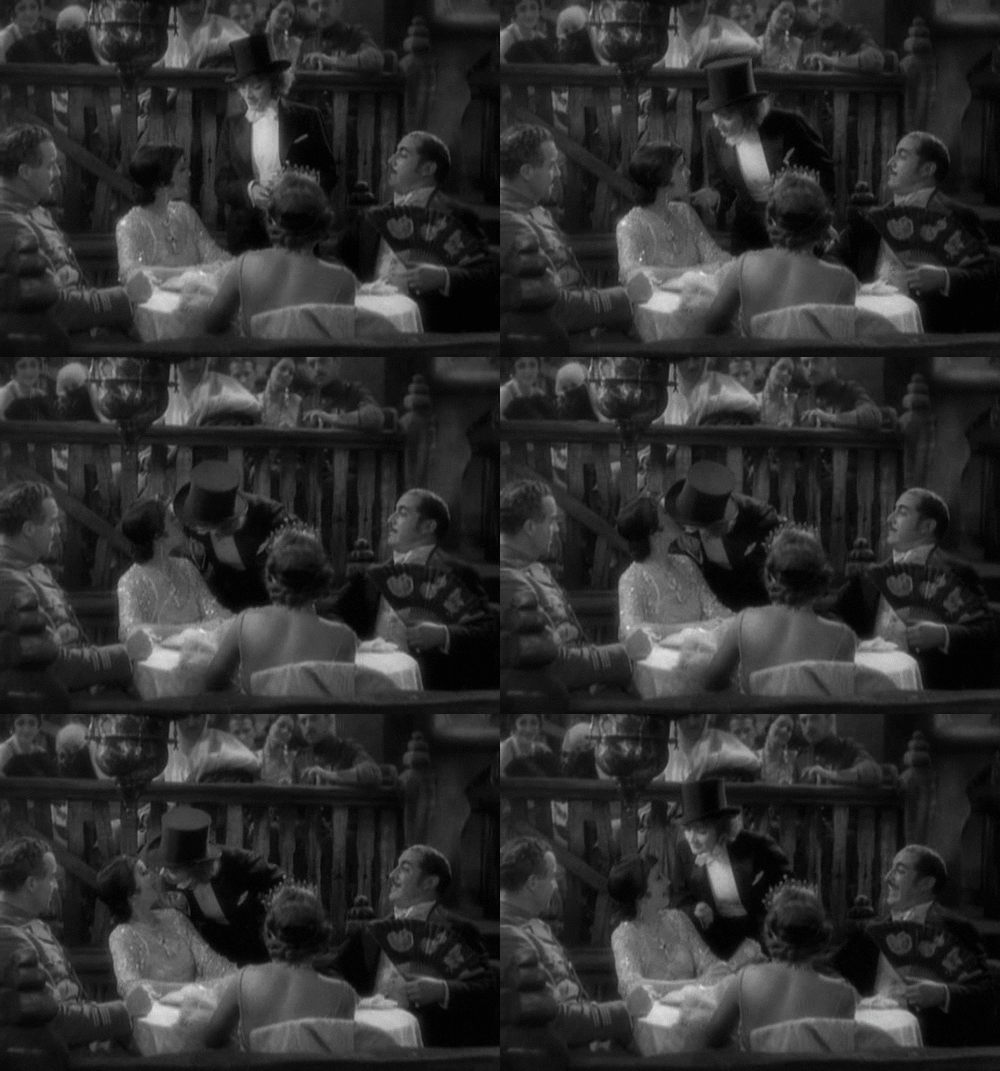
Morocco (Josef von Sternberg, 1930) Ladies and gentlemen, I give you Marlene Dietrich, in a tuxedo, swanning through a French song with nary a care, kissing a woman full on the lips. Ah, the glorious days pre-Hays Code! Movies have never quite recovered from that, have they? Anyway, Morocco is all about how the heat of the desert can inflame passions to the point of explosion, as Gary Cooper's foreign legionnaire romances Dietrich's lounge singer despite the fact that they both admit that neither one of them is in a good place to be having a romantic relationship. If you've never seen it, it's VERY much worth a watch.
The Adventures of Priscilla, Queen of the Desert (Stephan Elliott, 1994) From the sublime to the ridiculous...ly FABULOUS! Three Australian drag queens hop on a bus to travel to a gig across the country, upending expectations and bringing fabulosity wherever they go. When they aren't squabbling, that is. Featuring some beautiful scenery, mind-blowing costumes, and three unbelievably against-type performances by Terence Stamp, Hugo Weaving, and Guy Pearce. Priscilla looks at how the harshness of the desert landscape can bring out the harshness within us, if you aren't careful.
Beau Travail (Claire Denis, 1999) Extrapolating Herman Melville's famous novella Billy Budd into an elliptical examination of toxic masculinity and repressed homosexuality, Claire Denis's Beau Travail is completely brilliant, if you have the patience of a saint. Not gonna lie, this is a tough sit, but an utterly beguiling one, as a group of foreign legion soldiers in Djibouti is disrupted by the arrival of a pretty, young, innocent thing by the name of Sentain, who invokes the ire of their leader, Galoup. Passions can run high in the desert, so you need to watch your back.
Written as part of the weekly blogathon hosted by Wandering Through the Shelves. Join the fun (and scares!) by picking three movies that fit the week's theme and writing a bit about them.
Full disclosure: I was so caught up in the Presidential Debate last night that I completely forgot that today was Thursday. It was appropriate, though, since last night really was its own kind of horror movie, and we are devoted to things that go bump in the night this month on Thursday Movie Picks! Unfortunately, it's not science fiction, it's all too real... UNLIKE MY PICKS FOR THIS WEEK! #SeamlessTransition
My picks for this week all have something in common. Can you guess what it is?
The Invisible Man (James Whale, 1933) It's a bit of a risk casting a huge star as the lead of your movie and then keeping their face off the screen for the entire running time, but when you have a voice like that of Claude Rains, who needs a face? (And besides, this was Rains's American film debut, anyway) Rains is terrific in this, fully capturing the tension and the mania of someone being slowly driven insane by his own genius, which as resulted in a procedure that has rendered him invisible to the naked eye. The film also does a great job of capturing the feeling of HG Wells's book, equal parts funny, smart, and scary.
Invasion of the Body Snatchers (Don Siegel, 1956) When a number of his patients appear to be suffering from Capgras delusion (the belief that their loved ones have been replaced with identical impostors), Dr. Miles Bennell at first thinks it's probably just a small case of mass hysteria. But then he and a former flame find two giant pods with exact copies of themselves growing inside. And then they start to notice that the denizens of their small California town are increasingly losing all human emotion. What is going on? Are aliens behind this? Or is it.... even worse.... COMMUNISTS?!?!? One of the foundational texts of American cinema and pop culture, Invasion of the Body Snatchers still retains all of its icky paranoid power today, despite being remade - both directly and indirectly - countless times since.
The Fly (Kurt Neumann, 1958) A brilliant scientist has perfected a transportation machine. Or so he thinks. Well, I mean, it works. It works really well, actually. But the thing is, it can really only transport one thing at a time, in one direction. "Fine," you say. "What's the problem?" Well, the problem is, a fly happened to buzz its way into one of the transportation chambers when the scientist was testing it, and... well... I think you know what happens from there. Nowhere near as visceral as David Cronenberg's '80s remake, the original is very much a product of its time, meaning it's pretty scary, a little dated, and equal parts intentionally and unintentionally funny. Oh yeah, and it stars Vincent Price.
Written as part of the weekly blogathon hosted by Wandering Through the Shelves. If you don't know the deal by now, welcome! And why if you do, then come on in and join us! The water's fine!
Busybusybusy this week.
Let's do this quick and dirty style.
All Quiet on the Western Front (Lewis Milestone, 1930) Still one of the greatest Oscar Best Picture winners, over 80 years later.
Sergeant York (Howard Hawks, 1941) The beginning of my love affair with Gary Cooper.
A Very Long Engagement (Jean-Pierre Jeunet, 2004) Audrey Tautou, Gaspard Ulliel, Jodie Foster (speaking French), a very young Marion Cotillard, and Oscar-nominated cinematography. What more could you ask for?
Written as part of the weekly blogathon hosted by Wandering Through the Shelves. Come along and join us by picking three movies that fit the week's theme and saying a little something about them!
I'll get straight to the point. There is only one film with a female ensemble that matters, really. Every single one since is just a pale imitation. So let it be known that if you love movies at all, and especially if you love actresses, then you owe it to yourself to watch my first pick.
The rest are good, too, but they're not at all a patch on...
The Women (George Cukor, 1939) Yes, from Hollywood's annus mirabilis comes the greatest all-female ensemble ever assembled, getting to act one of its wittiest screenplays. When Norma Shearer's husband starts sleeping around with that hussy Joan Crawford, she goes out to a ranch in Reno so they can get a divorce.... and once that's done, she comes back to get revenge! The Women is an utter delight from start to finish. The only bad part is picking a favorite: Crawford, whose haughtiness makes it clear she's never anything but the lead in anything? Shearer, the all-too-human anchor who sends all her feelings straight through the screen directly to us? Paulette Goddard, the spitfire Shearer meets in Reno who could go toe-to-toe with any man? Mary Boland, delightful as the many-times divorced Countess who ALMOST puts over that she really does believe in "l'amour! l'amour"? Or the queen bee of fast-talkers, Rosalind Russell, whose gossipy gadfly may just be the true villain of the picture? I can't possibly choose. Can you?
8 Women (François Ozon, 2002) Only some of the greatest actresses in the world come from France, and somehow 90% of those are in this movie (the only biggie I can think of that's missing? Isabelle Adjani). Ozon's classic murder mystery setup (a man is murdered by someone he knows in his mansion in the middle of a snowstorm, everyone else tries to figure out which one of them did it) gets two twists: The first is that all the suspects are women. And what women! Deneuve! Ardant! Huppert! Béart! Darrieux! All cast perfectly to type and clearly having a blast with it. 8 Women is such a blast if only to get to watch these great actresses play off each other. What's that? The other twist? OH. It's a musical. Each of the titular eight women gets a character song to sing when the spotlight of the investigation falls on them. Not all of the ladies are good singers, but it doesn't matter; they know how to cover for their lesser abilities and perform the heck out of them anyway. It's stuff like that that make 8 Women such a joy.
Death Proof (Quentin Tarantino, 2007) BEFORE YOU START! Technically, this is NOT cheating. Yes, Death Proof was originally released as one-half of the Tarantino/Robert Rodriguez collaboration Grindhouse, but it also received a berth of its own at the Cannes Film Festival and was released on DVD as a solo feature (albeit both in a longer cut than in Grindhouse). And I'll be honest, the shorter Grindhouse cut is INFINITELY better than the longer "Director's Cut" version. But either way, Death Proof still has one of the greatest car chases ever committed to film, thanks to the brilliant casting of the great stuntwoman Zoe Bell (Uma Thurman's stuntwoman on Kill Bill) as one of a group of ladies who fall into the clutches of Kurt Russell's maniacal Stuntman Mike, who likes to crash his "death proof" stunt car into cars full of pretty ladies. Russell is at his magnetic best in the role, but it's really all about the two groups of women who fall victim to Mike (including the scorching hot Sidney Tamiia Poitier and Vanessa Ferlito) and who fight back (Bell, Tracie Thoms, and Rosario Dawson). The car chase that takes up almost an entire third of Death Proof is killer, but what's even better is what the ladies do once they catch up to the twisted Mike, the most cleverly edited scene of Tarantino's career, culminating in one of cinema's greatest finale freeze-frames.
Written as part of the series hosted by the lovely Nathaniel R. at The Film Experience, THE essential site for film lovers and actressexuals of all shapes and sizes!
What becomes a legend most?
Not caring. Not having any ever-loving fucks left to give. THAT is what becomes a legend most. For what does a legend care for the peons of the world - those people beneath her who would grovel at her feet for the chance of getting a glance from her ever-shrouded eyes, the "little people" who encompass most of us? ABSOLUTELY NOTHING.
Oh, she may have her reasons. She could be so insanely talented that everyday trivialities are nothing to her. She could be so unbelievably beautiful that she simply cannot bear to look at anything not as lovely as she. Or, she could have been hurt so deeply and so often over the course of her life that she has realized that there's nothing left in this world she could possibly give a damn about.
Except maybe this man. Because let's be honest, who wouldn't?
Josef von Sternberg's Morocco wasn't my introduction to Marlene Dietrich (that would be Alfred Hitchcock's Stage Fright), but it was my introduction to the work that defined her (with von Sternberg), and somehow I hadn't watched it until now. Well let me tell you, the lady is AMAZING. Amy Jolly is the baddest bitch on the seven continents and then some. Help her pack up her luggage after it collapses open on a boat? Whatever. Employ her to sing at your café in the titular country and give her advice on how to work the crowd? Alright, fine, if you must. But you best believe that when she does deign to pay attention to you, she will only do so with complete and utter disdain:
Silver Medal
Basically, that same insouciance that makes Buster Keaton one of the silver screen's greatest comedians makes Marlene Dietrich one of its greatest Divas. She is the living personification of the old adage "Less is More," and it took me seeing Morocco to realize it.
Bronze Medal
Watch as one by one she singlehandedly disarms every single man around her! Thrill to her shocking performance in... SHOCK... menswear! Gasp as she works the crowd by kissing a woman full on the mouth! IN 1930!!!
She kissed a girl. She liked it.
But when she finally gets Gary Cooper alone, she reveals where that give-no-fucks, take-no-prisoners attitude comes from. She's been let down by a few too many men. Turns out, her strength comes from a place of deep sadness, a mask she puts on to get through the day. We finally see the real Amy(/Marlene) in this shot, just as Cooper's legionnaire tells her that he wishes he had met her ten years ago - before he joined the Foreign Legion:
BEST SHOT
He's all but told her he loves her, and she looks like she's just been told she has forty-eight hours to live, like she's going back into hiding after sticking her nose out of her hole. Von Sternberg even has her dressed in black and boxed into the frame - here she is, in the same trap she's found herself in time and again, and the only way out is to cut it off now, before she gets in too deep. Again. What a beautiful character moment - one that makes you see her in a completely different (but still drop-dead sexy) light.
Written as part of the weekly blogathon hosted by Wandering Through the Shelves. Join in the fun by picking three films that fit the week's theme (this week suggested by yours truly!) and telling us about them!)
Well, they say March comes in like a lion and out like a lamb, and that's certainly true so far here in good ol' Manhattan - the winds have been whipping down the streets so strongly that sometimes they just push you right along your path. It's not awful but the wildly fluctuating temperatures are finally taking their toll on my body - I can just feel the cold coming on and I do NOT like it. I will be throwing everything in my arsenal at it in the hopes that it does not get worse, but I don't know... sometimes you can just tell when it's not going to go away...
BUT ANYWAY, who cares about my health (other than my mother)? We're here to talk movies!
One of the things the movies do better than any other art form is present "larger than life" events, which makes them ideal for showcasing the darkest side of Mother Nature. Unfortunately, most movies focused on such special effects-heavy adverse conditions don't have super-well-written scripts to go along with the impressive visuals, but I suppose you can't have everything.
Twister (Jan de Bont, 1996) I still remember seeing this for the first time in the local $2 second-run movie theater. I was 12. I don't remember if it was my first PG-13 movie or not, but I remember watching it in awe. Of nature, of moviemaking, of science... of just about everything on screen. Bill Paxton and Helen Hunt are exes and storm chasers who are flung back together for a series of mighty strong tornadoes - NOT AT ALL because they love each other, ONLY for the science! They have to get close enough to the tornado's path in order to drop a container of mini weather robots that look like metal balls. But also far enough away that they don't get sucked up into the tornado themselves. It's a dangerous game, but somebody's gotta do it, and they're both crazy enough to get right up in there to accomplish their goal - especially since there's also a rival, better-funded team lurking about. It's thrilling stuff, and the special effects still hold up - shocking for a film made twenty years ago. OH, and the name of the machine they created with all the weather robots? Dorothy. Which leads us to...
The Wizard of Oz (Victor Fleming, 1939) In which a Kansas farm girl gets knocked on the head during a tornado and proceeds to accidentally kill one woman and be manipulated by a pink-wearing bitch who travels in a bubble and a charlatan of a Mayor into murdering another in order to return home. OR MAYBE it was all a dream! Oh, I kid, I kid. Everyone alive knows The Wizard of Oz. By now, it's part of our cultural knowledge - it's seeped into our collective consciousness in a way no other film has, and with good reason: It's the simplest expression of all the possibilities of film, the perfect introduction to movies for anyone. To know it, is to love it.
The Impossible (J.A. Bayona, 2012) Ya know what? I don't care about the whitewashing. I really don't. Yes, the real family the story is based on was Spanish, not British, but when we got these amazing performances from Naomi Watts, Ewan McGregor, and Tom Holland, I don't really care. And on a purely technical level, this film is just astonishing. The sound design is one of the best, most inventive I've heard, putting you right there in the middle of the tsunami with these characters. It's a stunning film that deserved not one bit of the backlash it received.
Written as part of the weekly blogathon hosted by Wandering Through the Shelves.
Ah, romance is in the air this month for Thursday Movie Picks! This week, we're taking a look at the May/December romance: A relationship where there is a large age difference between partners, usually with one in their twilight years (hence the "December" part). Confession time: I spent the better part of the last decade in what some might describe as a May/December Romance - the gap between our ages was just over twenty years. He was still relatively young, though (it wasn't until towards the end of our relationship that he turned 50, so I wouldn't classify it as a May/December, although some might. That doesn't have an effect on my feelings towards May/December romances, though. Sometimes they're played for laughs, sometimes they're played straight, and I think that's true to how these types of relationships are in real life, too: Some are true love, and some are... well...
Gold Diggers of 1933 (Mervyn LeRoy, 1933) Yes, it's a trope nearly as old as the screen: younger girl falls (or "falls") for much older, much wealthier man. Now, I'm not saying Trixie Lorraine's a gold digger, but she sure as hell ain't messin' with no broke... OH WHO AM I KIDDING. They get married after ONE DATE. OF COURSE she's a gold digger! The plot of this pre-code musical doesn't really matter (a depression-era producer is trying to mount a show but doesn't have money, enter a secretly independently wealthy piano player whose family naturally comes to try and stop him), because it's all really an excuse to have some Busby Berkeley musical numbers. The most famous, justly, is "We're In The Money", the opening number sung by Ginger Rogers. I also love "The Shadow Waltz", which features some of the most ridiculous costumes ever created, just for ONE SHOT where the girls are shot from above to look like a flower. That Busby Berkeley. What a fucking genius.
Kill Bill (Quentin Tarantino, 2003/2004) The May/December Romance gone deadly. Beatrix (Uma Thurman) was very young when she first met the much-older Bill (David Carradine) and he took her under his wing, into his league of assassins, and somewhere along the way, into his bed. But after she became pregnant she decided she had to get out of the deadly assassin's life. To say Bill didn't take kindly to that is, well, putting it too kindly. Quentin Tarantino's fourth film was chopped in two for its release, and somewhere there supposedly is a cut that puts the whole thing together into one movie. I'd watch that in a heartbeat. Part One is an action-packed samurai extravaganza and Part Two is a bit quieter and more character-based. They balance each other out nicely (or at least, I imagine they do when put together). The saga of "The Bride" is probably Tarantino's best film, more than making up for its (relative) lack of ambition with stellar editing, cinematography, casting, and music (that trailer ALONE). And also pure awesomeness.
Twilight (Catherine Hardwicke, 2008) THAT'S RIGHT, BITCHES. Let's be clear: Edward Cullen may be in the body of a teenager, but in reality he is 104 years old. ONE HUNDRED AND FOUR. Sweet, mopey Bella is a teenager. That's one hell of an age difference. Twilight may be the wettest blanket of a romance ever put on screen, taking the soggy weather of the Northwest a bit too much to heart. Pity poor Kristen Stewart and Robert Pattinson, who have proven since that they really CAN act, when they're given actual characters to play.
Written as part of the weekly blogathon hosted by Wandering Through the Shelves. Join in the fun - a new year's the best time to start something new! - by picking three movies that fit the week's theme and writing a little something about them.
A new year, a new slate of Thursday Movie Picks! Wanderer has kindly posted this year's schedule, including a couple of topics suggested by yours truly! For this week, we're talking about the Downstairs folk. As in Upstairs/Downstairs. So, maids, butlers, kitchen staff... your Daisys, your Mrs. Hugheses, your Annas and Mr. Bateses... sorry, Downton Abbey just started a new season and I'm back to being obsessed again. Anyway, to the task at hand, this week's picks! Join me on this journey through history...
Farewell, My Queen (Benoît Jacquot, 2012) Sidonie Laborde is a servant in the court of Marie Antoinette. She's just gotten a promotion of sorts to be the Queen's reader. Even as things start to fall apart in France, Sidonie stays by the Queen's side, seeing life in the court and life in the servants' quarters from an increasingly unique perspective. Jacquot's film is notable, and all the more enjoyable, for showing us what life was like behind the curtain of the royal court - has there been another film that showed life in the servants' quarters of a grand palace? Plus, Léa Seydoux and Diane Kruger give excellent performances as Sidonie and Marie Antoinette, respectively.
Gosford Park (Robert Altman, 2001) Turns out, there's a hierarchy among downstairs folk that mimics that of the upstairs folk! Who knew? The lives of the downstairs side of the Upstairs/Downstairs equation is the real hook to Julian Fellowes's script, not the barely-even-solved murder mystery. Well, that and the performances by that murderer's row of great British thespians. Helen Mirren and Maggie Smith may have gotten the Oscar nominations, but Clive Owen, Kelly MacDonald, Emily Watson, Kristin Scott Thomas, Michael Gambon, Stephen Fry, and even Ryan Phillippe (among MANY others) do excellent work.
Gone With the Wind (Victor Fleming, 1939) Poor, poor Mammy. Oh, how she tries to help Scarlett O'Hara get through the South's loss during the Civil War. Lord only knows why she even stays with her afterwards, given that Scarlett is a right bitch to anyone that isn't named Scarlett or Ashley, but she does. Maybe it's to look after Prissy, who, let's face it, is kind of useless. I mean, REALLY. She doesn't know NOTHING about birthin' no babies?!? There's no use beating around the bush: Gone With the Wind is both glorious and maddening in equal measure, and I'm never quite sure on which side of that fence I stand. But hey, it's still the All-Time Box Office Champion when adjusting for inflation (and nothing will ever touch it), and there's good reason for that.
Written as part of the weekly blogathon hosted by Wandering Through the Shelves. Join in the fun by picking three movies that fit the week's theme and telling us about them!
Ah, hotels! The glamour! The romance! The allure of travel!
...or at least it used to be, way back when. Nowadays, hotels are either super-luxurious (and thus super-expensive) or cheap cinder-block rooms with barely any class to them at all.
Guess which I prefer?
The Gay Divorcee (Mark Sandrich, 1934) Not the best of the Astaire-Rogers pictures, but one of their earliest and most enjoyable. All the tropes of their films are set here, and in high style (the film received an Oscar nomination for Art Direction) at a European hotel where Ginger goes to stage an affair so she can get a divorce. Edward Everett Horton is her bumbling lawyer (and was there a better, gayer bumbler in Old Hollywood?) and ex-fiancee of her much-married Aunt Hortense (Alice Brady), Erik Rhodes the man she's supposed to get caught with, and Fred of course a friend of Horton's who once nurtured a crush on Ginger. If that all sounds like every other of the pair's films, then let me help: This is the one with "Night and Day", Betty Grable, and the fabulous 20-minute finale to "The Continental".
Last Year at Marienbad (Alain Resnais, 1961) One of the great mysteries of cinema, Last Year at Marienbad sort of defies description at a plot level. It concerns a man and woman meeting at a hotel. He says they have met before, she says they have not. But in the hands of screenwriter Alain Robbe-Grillet, founder of the "new novel", it becomes so much more: a treatise on memory, a puzzle to be solved, a gorgeous bauble to look at as a jeweler looks at a diamond.
Plaza Suite (Arthur Hiller, 1971) Neil Simon wrote three Suite plays (the other two are California and London), and this is the best. Three scenes take place in the same suite at New York's famed Plaza Hotel. These films perhaps don't feel like great choices for adaptations from the stage, as the plays are designed to take place on one set and make good use of the three-act structure, but the star turns from Barbara Harris, Lee Grant, Maureen Stapleton, and of course Walter Matthau, justify the film's existence. If you're allergic to Matthau, stay away, but otherwise, this is an alternately touching and funny picture.
Written as part of the weekly blogathon hosted by Wandering Through the Shelves. Join in the fun by picking three films that fit the week's theme and telling us about them!
Ready, steady, GO: Con Artists
...
uuuuuuuuuuuuuuummmmmmmmmmmmmmmmmmmmmmmmmmmmm....
...
Sorry, I'm still in a turkey coma from last week. Thanksgiving is my favorite holiday, and I had two celebrations, one on Thursday and one on Friday. This was my first year traveling to celebrate the holiday since college. And I was also cooking. So I missed last week's Thursday movie picks. :-(
So I wanted to be back this week with a vengeance.
Except that I forgot today was Thursday.
DAMMIT.
Oh well. I shall soldier on anyway! I've got one modern classic, and two Classic classics.
Ocean's Eleven (Steven Soderbergh, 2001) Effortlessly cool and with enough movie star charisma and swagger for eleven films, Soderbergh's update of the classic Rat Pack film is pure, endlessly rewatchable movie fun.
The Lady Eve (Preston Sturges, 1941) Barbara Stanwyck's seduction of Henry Fonda's dim-witted mark is one for the ages.
Trouble in Paradise (Ernst Lubitsch, 1933) Only Lubitsch could make a con film this sophisticated, sexy, and funny. Indelible performances from conwoman Miriam Hopkins and single socialite Kay Francis, as well as suave Hubert Marshall, the man caught between them.
Written as part of the weekly blogathon hosted by Wandering Through the Shelves. Come and join us - all you have to do is pick three films that fit the week's theme and tell us about them!
Welcome to October! That means it's Halloween month, and Thursday Movie Picks is celebrating with different scary-movie-themed picks every week. For this week, we turn to the "Master of Suspense", Alfred Hitchcock himself. The man has directed so damn many great films that it's practically obscene. I haven't seen all of them, but I have seen many of them (I had four full VHS tapes of them recorded from a TCM marathon when I was younger), and plenty of episodes of his great TV series Alfred Hitchcock Presents, too. Yeah, I guess you could say I'm a fan.
But... to pick just three? JUST. THREE?!?!?! Okay, fine. These are not my three favorites. Nor are they what I consider to be his three best (and yes, those are two very different things). They aren't even the three that I would tell people to start with if they had never seen even a single Hitchcock film before. These three are the ones that I think are his most underrated.
Sabotage (1936) - The most famous description of Hitchcock's style was given by the man himself, in his long-ranging interview with Francois Truffaut. It's the famous discourse on the difference between surprise and suspense - if you show a conversation between two people at a dinner table, and after a while a bomb explodes, that's surprise. However, if you show the audience the bomb under the table first, and then play the exact same scene, that's suspense. Sabotage, one of the last films he made in England before going to Hollywood, contains perhaps the most obvious - and cruelest - demonstration of that. It's only a five or six-minute sequence, but it feels twice that long for all the stress the film puts you through. Sylvia Sidney plays a woman whose husband owns a cinema. He's always been nice to her and her (much younger) brother Stevie, but she gradually begins to suspect that he's part of a terrorist gang planning a series of attacks in London. And then one afternoon, Stevie has to deliver a film canister to Piccadilly Circus...
Stage Fright (1950) - You know how everyone talks about Psycho and how shocking it was when Hitchcock killed off the film's biggest star by the halfway point? Well, he had been toying with audience's expectations and cinematic narrative conventions for years before that. Stage Fright is a bit of a lark, a trifle in a filmography as great of Hitch's, but its big twist is one of the greatest cinematic acts of pulling the rug right out from under the audience. Jane Wyman is Eve Gill, a young acting student who hides her crush, acting fellow student, from the cops, who suspect him of murdering his lover's husband. In order to prove his innocence, she becomes the temporary maid to his lover: the great actress Charlotte Inwood (Marlene Dietrich).
To Catch a Thief (1955) - I keep seeing people refer to this one as "lesser" or "minor" Hitchcock, and I just don't get it. No, it's not Vertigo or Psycho or Rear Window or even North By Northwest, but it's possibly the most purely entertaining film he ever directed, with one great scene after another. It's also boosted immeasurably by its stars, Grace Kelly and Cary Grant, neither of whom were ever more alluring than they are here. Retired jewel thief John "The Cat" Robie is forced out of retirement when a copycat criminal leads the police to interrupt his quiet, comfortable life on the French Riviera. He manages to convince an insurance agent to let him keep an eye on their wealthiest clients and their jewels in the hopes of catching the impostor in the act. Only it seems one of them, Frances Stevens, knows exactly who he is... and also has a bit of a taste for danger. This is apparently legendary costume designer Edith Head's favorite film she ever worked on.
BONUS: The Ten Best Hitchcock Films (according to me... my favorites will get their own post)
1. Vertigo
2. Psycho
3. Notorious
4. Rear Window
5. Shadow of a Doubt
6. The Man Who Knew Too Much (1956)
7. The 39 Steps
8. I Confess
9. Strangers on a Train
10. Rebecca
Written as part of the weekly blogathon hosted by Wandering Through the Shelves. Please join us by picking three movies that fit the week's theme and telling people about them!
Ever since the dawn of film, with the Lumière brothers' "L'arrivée d'un train en gare de La Ciotat" in 1896, the cinema has been in love with trains. It's hard to deny they make for pretty arresting viewing on their own, not really needing anything else to give them interest. As someone who commuted via train from Connecticut to New York City for work for seven years, I can say that the trains of today are not quite what they were: The modern sleekness has stripped away a lot of their grandeur. At any rate, these films inspired by trains are pretty great, and capture a lot (if not all) of what makes them so fascinating.
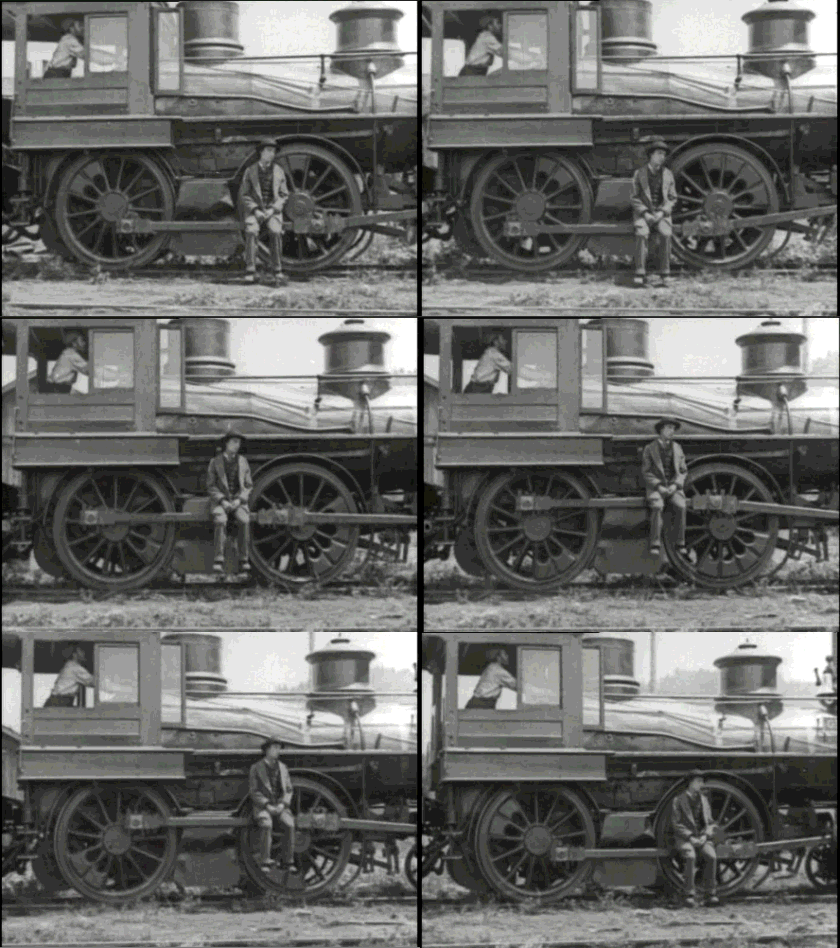
The General (Clyde Bruckman and Buster Keaton, 1926) Buster Keaton is a genius. A goddamn genius. The physical stunts he did are pure madness to even attempt, but he executes them with such flawless ease that it makes me jealous. And to top it all off, "The Great Stone-Face" has no flair whatsoever. He just tosses off every single death-defying stunt like it's nothing. Like he's bored. Oh, a house just fell down around me. Whatever. Oh, I just narrowly avoided getting shot by a canon which I loaded after running along a moving train, that's all. No big whoop, just another day on the job, wasn't even any fun. It's sick. The General, perhaps his finest hour, he gets the girl by rescuing both her and his beloved train in the midst of the Civil War. Shockingly, it's actually (slightly loosely) based on a true story.
The Lady Vanishes (Alfred Hitchcock, 1938) Hitchcock's British pictures are quite different from his American ones, and I don't think that difference is more apparent than in this film. It's a sly little thriller, yes, but it's also a light comedy, something that, while an element of some of Hitchcock's later pictures, could never really be called a defining trait of any of them. That it works so breezily well is due in part to Hitch, but mostly to his fine, fine cast: Margaret Lockwood as our heroine, Michael Redgrave as her impossibly dashing foil, and of course Dame May Whitty as the titular old lady who may or may not have even existed in the first place. And let's not forget the delightful Basil Radford and Naunton Wayne as Charters & Caldicott, such perfectly British supporting characters that they were drafted to appear in two other completely different films (one of which, Night Train to Munich, not only also takes place on a train, but also co-stars Margaret Lockwood) and had a mini-series all to themselves. The Lady Vanishes is pure pleasure.
20th Century (Howard Hawks, 1934) Okay, yes, this is really only here because I've performed in the musical based on this film and it's so, so bad. But the film is fun. I mean, I ask you: Can you go wrong with a Howard Hawks-directed screwball comedy starring Carole Lombard and John Barrymore as sparring, egotistical theater folk? You cannot, my friends. You truly can NOT.
Written for the blogathon hosted by Wandering Through The Shelves. Join us - just suggest three movies on the weekly topic!
This week's Thursday Movie Picks are for the "All in the Family Edition" which will run on the last week of every month. This month the subgenre is "Married Couples Movies", and wow is that a toughie. SO MANY MOVIES centered around married couples! I haven't gone very far back in time for most of my recent picks, so this week I decided to go all Classic Hollywood with three of my most favorite screen couples.
The Thin Man (1934, W.S. Van Dyke) William Powell and Myrna Loy are unquestionably my favorite screen couple. Their relationship in The Thin Man is just too good to be true, in that old-school banter kind of way. While it's clear they love each other, neither of them have trouble dishing out the sass when it's called for. I guess this is what you get when an actual married couple write a screenplay - and this really is one of the greatest screenplays ever written (there's also a murder mystery in there somewhere, but make no mistake: the central relationship is the real star of the show). I probably quote it weekly, if not daily. "Oh, Nicky, I love you... because you know such lovely people!" "He didn't come anywhere near my tabloids!" And of course, the martinis. And that glass of rye. And "the nicest dinner I ever listened to." I could watch this movie on a loop forever and be completely satisfied.
Topper (1937, Norman Z. McLeod) After the fun-loving Kerbys (Cary Grant and Constance Bennett, both delightful) die in a car crash, they become ghosts. Believing that they haven't moved on because they've been too irresponsible to do any truly good or truly bad deeds, they decide to help their stuffy friend Cosmo Topper (Roland Young) start to enjoy life (a "good deed" only by Hollywood standards). Of course, old habits die hard, and they largely treat the afterlife as an extension of their actual lives, causing mayhem and merriment embodied by some of Hollywood's cleverest special effects. Topper is undeniable fun thanks to these two, and as Topper's snooty, social-climbing wife, Billie Burke (yes, Glinda from The Wizard of Oz) makes a hilarious foil. Also, Young's physical comedy as the Kerbys invisibly walk a drunken Topper through his building's lobby is a riot - as impressive as it is funny.
Adam's Rib (1949, George Cukor) Katharine Hepburn and Spencer Tracy made nine movies together, and for my money, this is the most enjoyable. And they make for formidable competitors as Adam and Amanda Bonner, married attorneys who find themselves on opposing sides of a case involving a woman who shot (but didn't kill) her unfaithful husband. Garson Kanin and Ruth Gordon's great screenplay is perfectly mixed honey and vinegar. Okay, sure, the gender politics don't quite track, but I totally buy the "battle of the sexes" anyway. Hepburn and Tracy are on fire; no one fought onscreen quite as well as they did. Plus, a hilarious turn from Judy Holliday as the woman on trial.
BONUS: Mr. & Mrs. Smith (1941, Alfred Hitchcock) No, not that Mr. & Mrs. Smith. This one stars Carole Lombard and Robert Montgomery as a slightly unhappy married couple who learn that through a legal snafu, they aren't actually married. It's the only romantic comedy Hitchcock ever directed (done as a favor to Lombard), and it's good, even if it is decidedly minor Hitchcock.
Sometimes it's the dancers that are famous, sometimes it's the choreographer. Busby Berkeley was in all likelihood the first choreographer to fully recognize the potential of film as a tool to showcase dance in new ways. "Dance Until the Dawn" is from the 1931 musical Flying High, with Bert Lahr and Charlotte Greenwood. It wasn't first Hollywood production Berkeley choreographed (that would be 1930's Whoopee) and it certainly wasn't the last. Most of his signature moves are all here: the chorus girl "parade of faces", the synchronized precision line dancing, and of course the hypnotic bird's-eye-view kaleidoscope shots.
It's interesting to note that Berkeley wasn't credited as a Director on any film until 1933's She Had to Say Yes, despite having served as choreographer on 11 films before. He was apparently given a degree of independence in the direction of his musical numbers; they always have a very distinct style almost completely separate from the non-dance scenes in those early films. Did Berkeley's style come from the directors of those early pictures, or did it come from within? The general consensus seems to be that it all came from him, and I find it hard to disagree. The man was a genius. He was a visual artist using human bodies in motion to create a living work of art in a way that had never been done before.
This is from one of his earliest films, so some of it is a little rough (the dancers are notably not as tight as usual for Berkeley), but it's still hugely enjoyable in a way that only Busby Berkeley numbers are. He really showed off as much of the work of putting the film together as he could - look at those costumes on full display as the chorines enter, and later when they spin around! look at that multi-level set! look at each of these girls' faces! - which makes him even more unique among choreographers, who really do tend to be all about the movement.
Not that Berkeley didn't care about movement as well. Quite the contrary. After establishing the ensemble, the costumes, and the set, he goes about creating some great images - images that audience members couldn't possibly see if this number were performed on stage in a theater. I'm not just talking about those famous bird's-eye-view shots, either. There's one moment in particular (it comes at around 2:41 in the clip) that would be almost completely lost on theatregoers, and might have even been lost on the cinema patrons of 1931. While that line of men coming through the wheels of girls may have evoked gears to most, and might have received applause onstage as such, looking at it from this angle - one much higher than even the balcony seats in the theater - it's near-impossible to not see the sexual subtext.
Can't un-see it now, can you?
But moving on to those kaleidoscope shots. They really are unlike anything else on film. Pure poetry. You'd be forgiven for thinking it was special effects - completely animated, or each layer shot separately - but it's all done for real, in camera. There is something about bodies moving in unison that never fails to evoke wonder and amazement in human beings. It's one of the reasons why the Rockettes are still getting standing ovations for their kicklines after nearly 90 years. It's sublime, really.
If I can get a little serious, in intellectual circles "the sublime" is defined as the terribly beautiful. Watching a large group of human bodies in complete synchronization is beautiful, wondrous, even, but also unnatural and scary - we are creatures of free will, after all! Think about it: Other than chorus girls, what group of people most often march in strict, synchronized formation? Soldiers.
But enough with the serious, high-falutin' stuff. Busby Berkeley numbers are eye-popping in a way you just don't see anymore. Using the human body and the camera in perfect harmony, he created some of the most amazing sights you'll ever see. He really was the first person to conceive of dances almost exclusively for the camera, and even our greatest choreographers (Gene Kelly, Jerome Robbins, Bob Fosse) couldn't match his ingenuity with a lens. What he did was so singular, even those later geniuses knew not to touch it. Dance on film has come a long way, but there's still nothing like a Busby Berkeley extravaganza!
(Written as part of the "Hit Me With Your Best Shot" series over at The Film Experience.)
In my Junior year of High School, we had to do something called "The America Project". We had to pick something - an idea, a place, a person, a thing - and present a portfolio explaining why that something is American. I, of course, picked the movies. The final product wasn't very good, for a lot of reasons, but I was a good enough writer to still get a B on it (although, to me, that was as good as failing. I'm serious). In my Senior year, I wrote my final research paper in Advanced Placement US History on L. Frank Baum's The Wizard of Oz as the first American fairy tale. Clearly, that idea came one year too late. Because is there anything more American than MGM's 1939 film of The Wizard of Oz? I mean, besides apple pie and baseball?
It’s hard to think of another movie as well-known or as
well-loved as The Wizard of Oz. It's so much a part of our collective DNA that it feels like we are all born into this word knowing the story, the songs, and the performances. In reality, Oz was just another film from one of Hollywood's Golden Years, until it became the first Hollywood film to be shown in one evening, uncut, on a commercial network. For many years between 1959 and 1980 (the years when it was shown on television
as an annual special event), 49% of American households watched it. Nearly half of America tuning in to watch the same movie, for years on end. When people
make the claim that Oz is the most-watched film of all time, it’s easy to
believe it. It’s also easy to say that television made Oz what it is today. Without those yearly airings,
would it be as popular as it is?
My instinct says yes. Because it’s not just nostalgia that
makes people love Oz so much. It’s a
really well-made movie, yes, but it’s more than that, too. It’s the magic of the
movies, pure and simple.
In every frame, The Wizard of Oz shows us what movies can do that no other medium
can. It can transport us, break the fourth wall in ways that theater, music,
and dance just can’t. No matter how many times you see it, every time Dorothy
opens her front door onto this new, strange, colorful world and surveys
Munchkinland, it feels like the first time. Everything, the camerawork, the
effects, the crafts, and the music, put you in that place. Everyone becomes a
kid again in that moment, whether or not they watched The Wizard of
Oz regularly as a kid. This is something
that can really only be done in the movies, and even then only a select few do
it as well as The Wizard of Oz (Star
Wars and… The Lord of the Rings? Avatar?).
Given the collective love for the land of Oz, and all its
inherent beauty, it may come as a surprise that my favorite shot is from the
Kansas portion of the film. But then, if those opening scenes weren’t so great,
we wouldn’t care about Dorothy’s journey. The decision to tint those scenes
sepia is so smart. For a long time, the Kansas scenes were shown on TV in black
& white, and I have to imagine that robbed the film of a lot of is beauty –
the sepia makes Kansas feels not just drab, but a bit dusty in a way B&W
does not, and in a way that enhances the feel of those scenes (and to the
nostalgia of those watching, I imagine). But whether in sepia or in black &
white, I think my favorite shot stands out.
It comes right after the timeless “Over the Rainbow”, easily
one of the most beautiful songs ever written. Whenever I watched The Wizard
of Oz as a kid, this shot had a really
strong hold on me. It was an oasis, always prompting a contented sigh. For a
little boy who so desperately wanted to go over the rainbow to Oz, through the
looking-glass to Wonderland, or into the wardrobe to Narnia (or later, through
a fake wall to take a train to Hogwarts), this was the epitome of everything I ever
dreamed of. The ultimate escape. Even though it’s in sepia tones, to me, it was
always in colors as bright as they are in Oz. Come to think of it, it's actually the first shot of that land beyond the moon, behind the rain:
Just as with that first scene in Oz, it isn’t the image alone that makes this shot work. The dimming music cue, the sound of
birds, and the look on Judy Garland’s face in the shot immediately
before it combine to give this image a huge impact. If you've ever dreamed of something better, of being something greater, of doing something more with your life, this shot speaks to you. And if you're a nerdy little boy who loves reading books more than anything, who always gets picked last in gym class, and who only has one friend in the world that isn't a stuffed animal or an action figure; who wants nothing more than to make friends and go on adventures... well, that one shot offers more hope than a whole lifetime of "It gets better"s. That's why The Wizard of Oz endures. That's the power of the magic of movies.